


Hi, I’m Greg 👋! I write weekly product essays, including system “handshakes”, the expectations for workflow, and the jobs to be done for data. What is Data Operations? was the first post in the series.
This week’s toy: robots are now installing solar panels, and doing a pretty good job at it. When industrial robots are doing things outside the factory, this sets a pretty interesting precedent for the future of work.
Edition 284 of this newsletter is here - it’s December 29, 2025.
Thanks for reading! Let me know if there’s a topic you’d like me to cover.
The Big Idea
A short long-form essay about data things
⚙️ 5 Customer Journey Axioms Teams Actually Use
Product-led teams often talk about their customer journey as the measure for delivering the customer promise. When they spend more time building a journey map in Figma than translating it to clear principles for the engineering team, that journey doesn’t always transfer.
Want to know if your customer journey is working?
Look at your top support tickets and see if they change month over month. If the same issue shows up week over week and month over month, you don’t have a support problem. You have a product decision problem that is failing to solve a key product need your customers keep hitting.
Now comes decision time. Does the customer behavior happen because you have the wrong customers, or because they don’t know what to do? Most teams want to keep their customers, so they need to get better at telling customers (and internal teams) the intended customer behavior.
Your customer journey isn’t defined by your intentions, but the tradeoffs you make under pressure.
You need a small set of customer axioms to guide the teams in the moments whern the product team is not in the room.
Poster principles don’t give enough detail
Most companies already have “values” that sound like customer axioms:
“Be customer-first.”
“Delight users.”
“Make it easy.”
“Build trust.”
These are great principles, but they’re hard to operationalize.
These statements don’t tell you what to do when you can either ship a feature or clean up the confusing workflow that generates 200 tickets a month. They don’t tell you what to do when a product change will improve margins but create a new class of “what happened?” support threads because enablement lagged the release.
Customer journey axioms – shorthand observations or rules that teams can follow in a process or procedure – give the team clear steps when they are under pressure and need a next step.
What’s in a customer journey axiom?
A customer journey axiom has four parts:
Claim (memorable)
Tradeoff rule (what wins when priorities collide)
Forced behavior (what it requires in the product)
Proof hook (how you’ll know it’s working)
If you can’t attach proof, your axiom loses credibility. If you can’t name the tradeoff, no one will trust that they can use it effectively.
Five example axioms that build confidence
The ideas are written to improve the whole customer journey with support acting as the early-warning radar for the business.
Axiom 1: The customer should always know what happens next
Tradeoff rule: When speed conflicts with orientation, choose orientation.
Forces in the product: clear states, next steps, progress indicators, ownership (“who is doing what”), and visible completion criteria.
Proof hook: fewer “what now?” tickets, fewer follow-up pings, fewer duplicate submissions.
If users can’t tell what’s happening, they start doing the worst possible behavior: guessing. Guessing creates retries. Retries create duplicates. Duplicates create irreversible messes. Messes create escalations. Escalations create churn stories.
This is why “what happens next?” is not a UX nice-to-have.
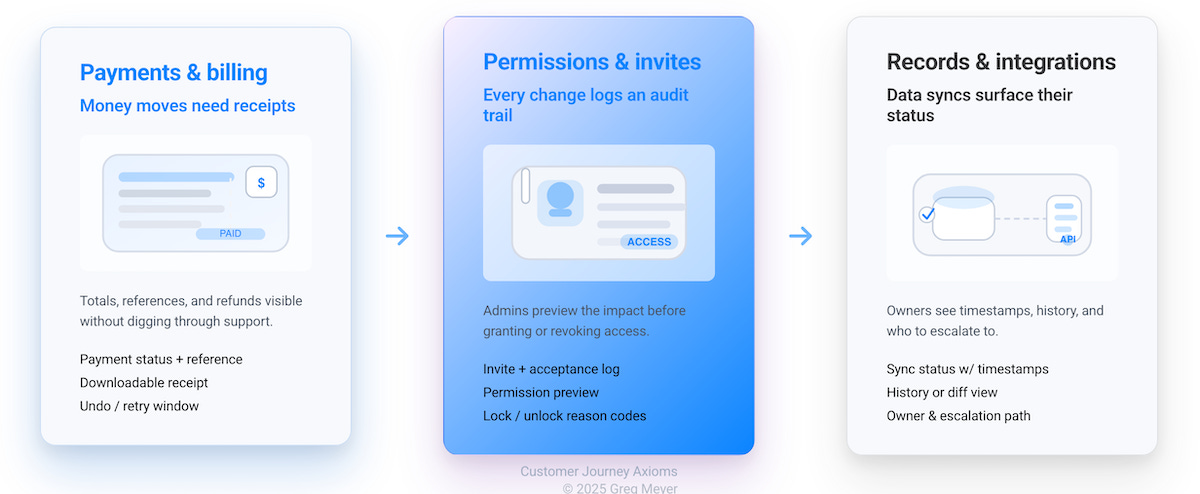
Axiom 2: Every meaningful action creates a receipt
Tradeoff rule: If an action changes money, data, access, or commitments, it must be confirmable and recoverable.
Forces in the product: confirmations, status pages, “view details,” audit trails, undo/retry, and durable reference IDs.
Proof hook: fewer “did it go through?” tickets and fewer “I did it twice because nothing happened.”
A receipt is not a toaster notification. It’s evidence.
A customer should never have to open a ticket to answer:
Did my payment succeed?
Did my invite send?
Did my integration connect?
Did my request get queued?
Did my change actually apply?
If they have to ask support, your product shipped the work of reassurance to humans.
Axiom 3: No silent failure, no hidden work
Tradeoff rule: If something fails, it must fail loudly and informatively for the customer (not just for logs).
Forces in the product: explicit error states, human-readable causes, constraints communicated early, and graceful recovery paths.
Proof hook: fewer “it just didn’t work” mysteries, lower time-to-diagnosis, fewer multi-touch tickets.
Teams will instrument the backend beautifully, then leave the customer with the equivalent of a blank screen and a prayer.
Silent failures don’t just create tickets. They create doubt. Doubt doesn’t stay in support; it contaminates retention and referrals.
Axiom 4: Trust beats speed in money/data/access moments
Tradeoff rule: When a change risks surprise in billing, permissions, or data correctness, trust wins — even if it takes longer.
Forces in the product: previews, confirmations before irreversible actions, clear permissions language, transparent billing changes, reversible flows where possible.
Proof hook: fewer escalations, fewer billing disputes, fewer “you changed my access” panic threads.
People forget a slow feature. They don’t forget a billing surprise. They don’t forget “we lost your data.” They don’t forget “my account got locked and no one can tell me why.”
Trust is a product surface. Treat it like one.
Axiom 5: Repeated confusion is a product bug
Tradeoff rule: If the same confusion repeats, the fix belongs on the roadmap ahead of “nice-to-have” features.
Forces in the product: root cause analysis, simplified flows, guardrails, better defaults, and deprecation of confusing paths.
Proof hook: top ticket drivers trend down month over month; re-open rate drops.
If your support team can predict tomorrow’s tickets, your product team can too. And if you can predict it, you can prevent it.
The goal isn’t “fewer tickets.” The goal is less repeat pain.
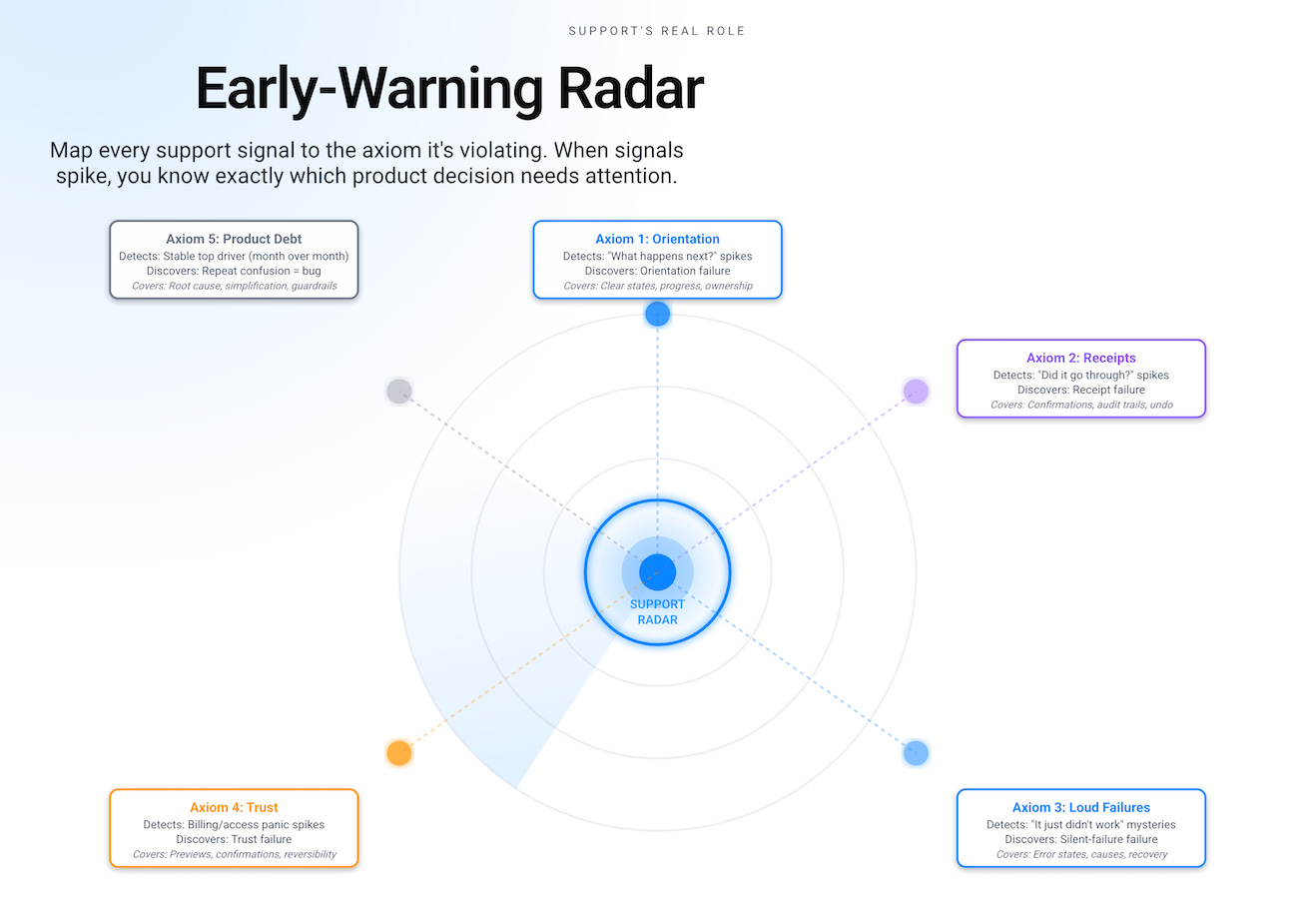
Support’s real role is early-warning radar
Support is where the journey shows you its weather.
Tickets, chat logs, re-opens, and “any update?” pings are radar returns. These are weak signals that something upstream is getting unstable. The product team won’t see it in the roadmap. Sales won’t see it until deals slow down. Leadership won’t see it until it’s counted and shows up in a report.
That’s why the goal isn’t “close tickets faster.” The goal is to treat support as a signal system that protects the customer journey from repeat turbulence:
A spike in “what happens next?” is an orientation failure (Axiom 1).
A spike in “did it go through?” is a receipt failure (Axiom 2).
A spike in “it just didn’t work” is a silent-failure failure (Axiom 3).
A spike in billing/access panic is a trust failure (Axiom 4).
A stable top driver month after month is product debt (Axiom 5).
If you can’t translate support signals into the axiom they’re violating, you don’t have customer journey governance.
You have customer journey weather reports you ignore.
Introducing these practices in your company
Like any other “big idea”, these practices don’t stick until teams try them, make tweaks to adopt them as their own, and do them the second (or fifth, or thirtieth time).
If they are not simple enough to add “just one thing,” they might be too much change at one time. Here are a few ideas to get started:
Put axioms in the PRD template
Add one mandatory line:
“Which axiom does this advance, and which axiom does it risk?”
If someone can’t answer, you’re about to ship a feature that feels “useful” but quietly rots the journey.
Run a weekly Radar Sweep
Take fifteen minutes each week to review progress, using the following agenda once you’ve instrumented some reports:
Top 5 signals (volume and severity)
Which axiom is being violated?
Is the response: product fix, guardrail, communication, or instrumentation?
What threshold triggers escalation next time?
Radar is only useful if it changes behavior before the storm hits.
Keep it simple
Choose one proof metric per axiom (and one guardrail):
Axiom 2 metric: “did it go through?” ticket rate
Guardrail: successful completion rate
You’re trying to reduce confusion without creating friction.
Objections (and the point)
You’re going to hear some objections to this approach. They might sound like some of these statements:
“Axioms oversimplify.”
Good. The alternative is debate theater, inconsistent experiences, and a journey that changes depending on who you talk to.
“Axioms will conflict.”
Also good. That’s why they’re a constitution: when they conflict, you surface the real tradeoff instead of pretending everything is “customer-first.”
“We already have values.”
Values are identity. Axioms are operating constraints. Your customers don’t churn because your values are unclear. They churn because outcomes are unpredictable.
Meeting the challenge
Pick one part of your journey you’re secretly ashamed of — the place where customers get stuck, surprised, or forced to ask a human for reassurance.
Write the axiom that would have prevented it.
If it doesn’t change next week’s roadmap conversation, rewrite it until it does.
That’s how you know the customer journey is real: not when it’s mapped — when it’s enforced.
What’s the takeaway? Support is early-warning radar. Building product axioms to define when we’re breaking the customer journey helps you to know how to separate a garden-variety bug from a critical product issue.
Links for Reading and Sharing
These are links that caught my 👀
1/ A🍕 team might beat a 🍕🍕 team - the main reason a small team can beat a bigger team? Less cross-team communication needed. The coordination tax is real.
2/ Touch that dial, not that screen - car makers are finally realizing that touchscreen controls provide the same level of disorientation as driving while impaired. It’s time to bring back the dial.
3/ Behold, the robot olympics - one of my key indicators for robot performance is the ability to do real-world tasks like laundry-folding, dishwashing, and other household tasks. How are we doing on that so far? Not as far away as you might think.
What to do next
Hit reply if you’ve got links to share, data stories, or want to say hello.
The next big thing always starts out being dismissed as a “toy.” - Chris Dixon