


Hi, I’m Greg 👋! I write weekly product essays, including system “handshakes”, the expectations for workflow, and the jobs to be done for data. What is Data Operations? was the first post in the series.
This week’s toy: a pair of sneakers that let you play classic NES games. Slightly awkward to have to take your shoes off to play some games, but amazing to have a portable game system with you to do it.
Edition 279 of this newsletter is here - it’s December 1, 2025.
Thanks for reading! Let me know if there’s a topic you’d like me to cover.
The Big Idea
A short long-form essay about data things
⚙️ Avoiding the Telephone Game
Note takers - even the robot notetakers we are using these days to capture meetings - are prone to the telephone game. By this, I mean the tendency for the meaning of a meeting to drift over time.
Do you really know what happened after a meeting, and how you’re going to take action after the meeting?
At the very least, you need the three-line handoff:
What you must receive
What you must validate
What to do next
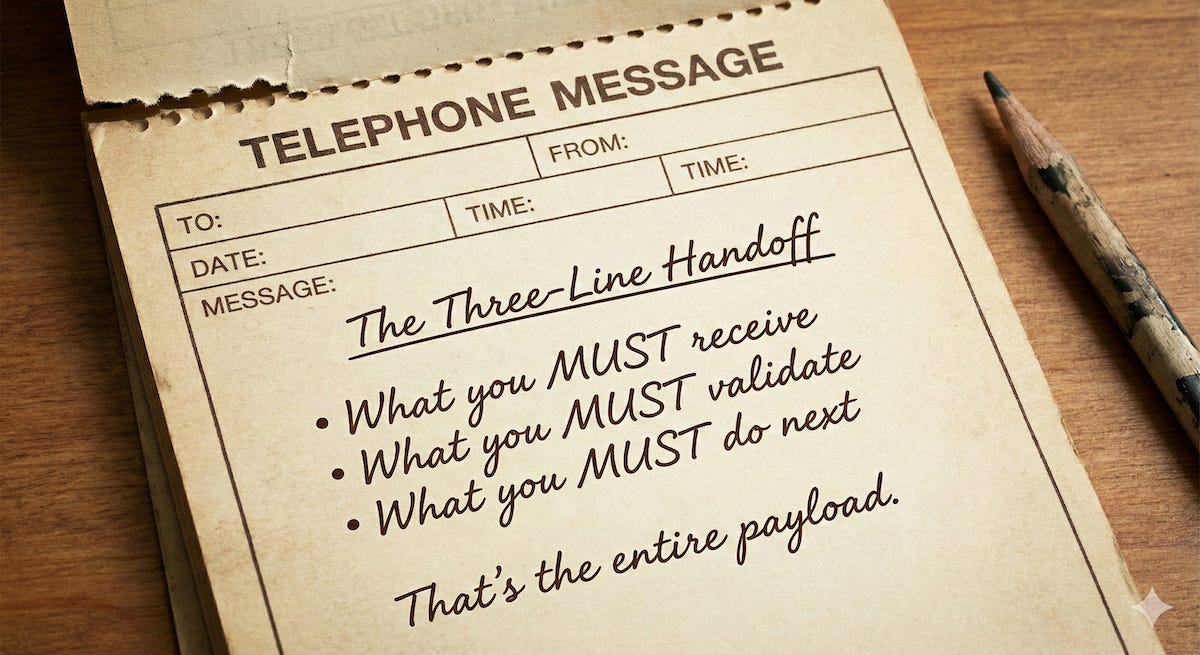
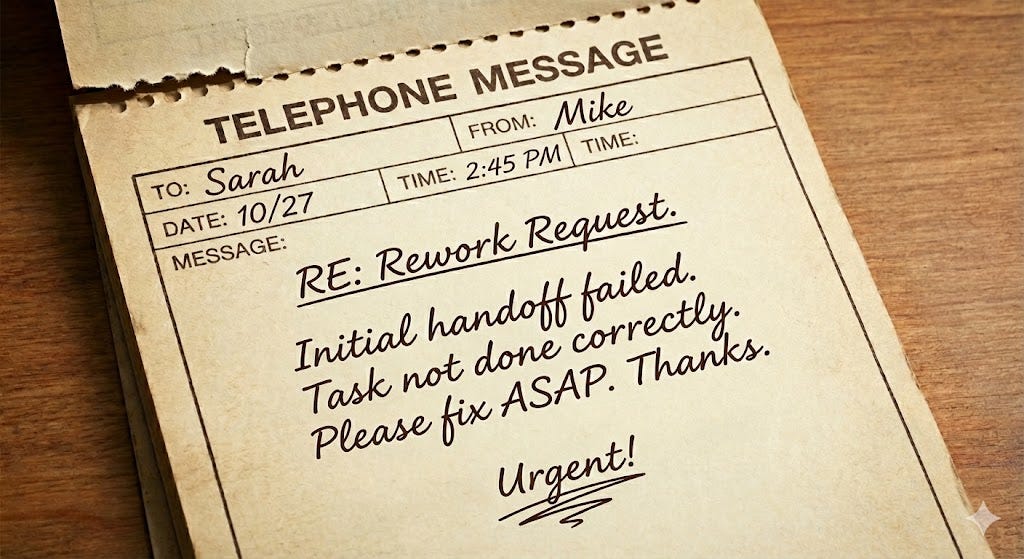
What’s a great example of this technique? That old telephone message pad that you’ve probably never seen if you’re younger than 40. I needed to use AI to visualize what this looked like because we don’t use this artifact anymore.
Why did it work? It was a simple workflow tool indicating WHO called, WHEN they called, and WHAT they wanted.
Depending upon the skill of the notetaker, it also indicated how to close the loop. The assumption of this tool? That whoever reads it has enough context to use this message to determine what’s missing.
It was somewhat of a leap of faith. If your sibling filled out this information on a pad next to the (probably wired) phone, they probably didn’t do more than write down the name of the person who called and their phone number.
Good luck on knowing the time of the call or gaining a deeper understanding of why the phone call happened.
This didn’t work 100% of the time when people answered their phones or when you counted on someone to answer your phone for you.
So why are we confident that AI notetakers can do a better job?
It’s easy to assume that they got everything. They are confident, produce a tidy summary, and are really good a jogging your memory to identify what happened in the few hours after a meeting.
But beyond that point, they are not as useful as that summary promises to be.
Where work falls apart
The reason that AI-driven summary doesn’t always work the way we expected stems from the same root as other misunderstandings. None of the individual steps are wrong, but something about it doesn’t hang together.
Here’s the analog in a process you might see every day:
Support escalates something to Product
Product forwards it to Engineering
Engineering hands off to QA
The team loops in Compliance
Compliance sends something back to Support
Where’s the error? No single step is broken, but the expectations and boundaries are not consistent across teams.
Every transition introduces:
slightly different interpretations
mismatched assumptions
format changes
“we thought you meant…” moments
By the end of the journey, you’ve played the Telephone game, and you might end up working on disjoined projects.
Handoffs are not specific enough
It’s too easy to turn a “one pager” into a “too many pages, I didn’t read it” using AI. That’s the first response to extra requirements. Think of that effect as documentation scope creep. The problem with this output is that you get more surface area for interpretation.
Instead of a crisp set of instructions, you end up with an 80% solution that gets misinterpreted.
The solution to this is the three-line handoff. Every handoff — human-to-human, human-to-AI, or AI-to-human — should contain exactly three things:
What you MUST receive - the minimum valid inputs required to begin the next step.
What you MUST validate - Simple, zero-interpretation checks. (Not judgment. Not context reconstruction.)
What you MUST do next - A single explicit action that advances the work.
This gives you a low-effort, high value map to improve handoffs.
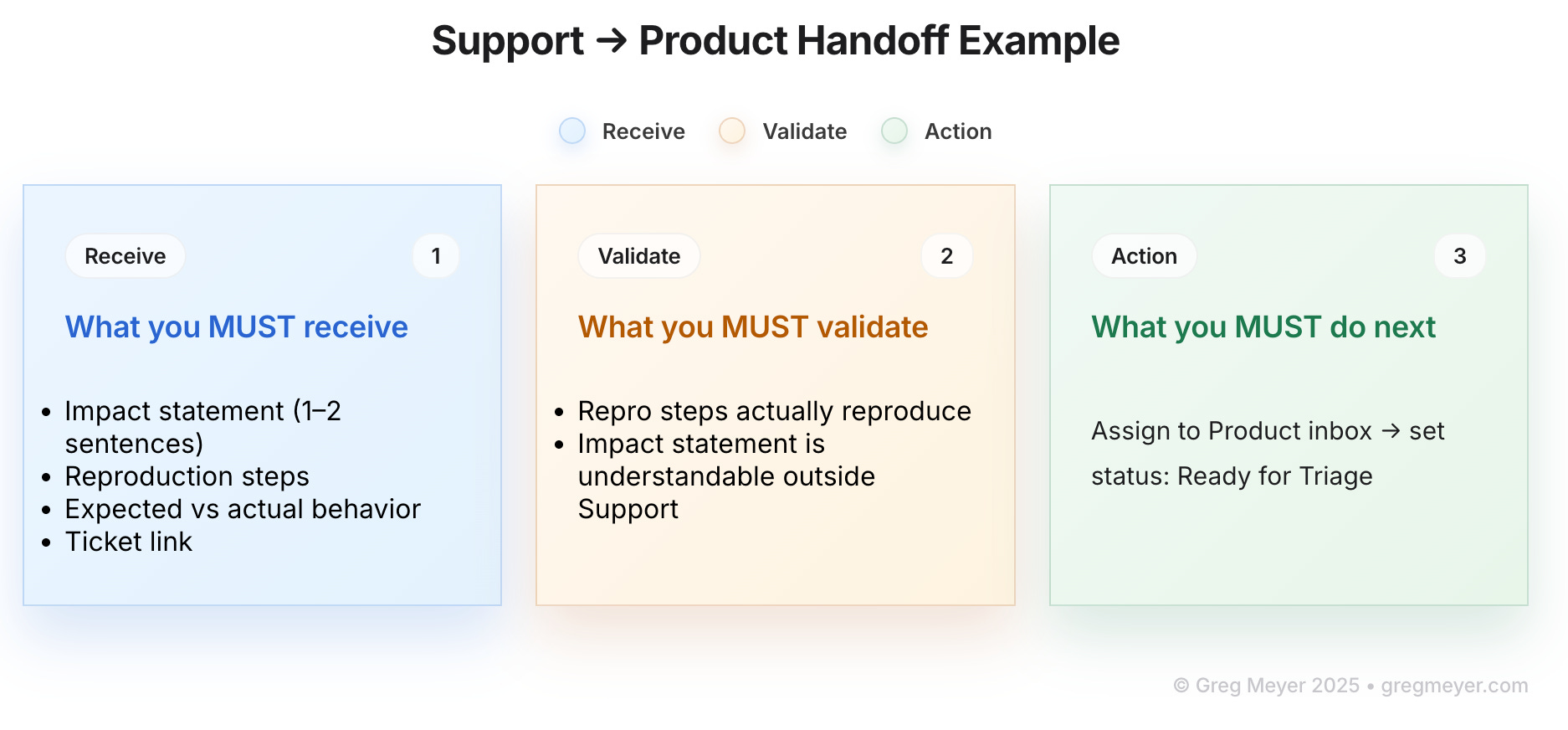
Creating a concrete handoff example
Let’s take a common hand off instance between support and product. You’re probably used to seeing a ticket with a wall of text, a screen shot, and a comment: “this feels like a bug.”
This could be better with a three-line handoff added.
1. MUST receive:
Impact statement (1–2 sentences)
Reproduction steps
Expected vs actual behavior
Ticket link
2. MUST validate:
Repro steps actually reproduce
Impact statement is understandable outside Support
3. MUST do next:
Assign to Product inbox → set status: Ready for Triage
This is the difference between a telephone-message-style note and a boundary designed to prevent drift.
Clarity matters more when AI is in the loop
The “telephone game” works a lot of the time because humans are pretty good at inferring intent from lossy, incomplete information. When we read the AI-created summary from the meeting we had yesterday, it’s easy to pick out an additional thing that adds context based on what you remember.
AI can’t add this context because it’s not present in the artifact. When messages are ambiguous:
AI fills the gaps and rewrites the context
AI smooths over inconsistencies and makes it sound polished
Occasionally, AI manufactures the wrong detail
The message recorder is not doing this on purpose, but summarizing according to its prompt. With a perfect transcript, it can probably do a pretty great job of identifying action items, summarizing the outcomes of the meeting, and setting reminders. But most transcripts are not linear or perfect.
How can we do better?
Pick one workflow boundary, and then ask the two teams involved:
What do you think the other team needs?
What do you actually need?
What’s always missing?
What usually creates rework?
What would allow you to start immediately, without clarification?
The output of this exercise is your three-line handoff. Practice using this and collaborate so that everyone who needs to know this new handoff does it well. Then, move on to the next bottleneck.
Closing back to the image
The telephone message pad was designed for a world where you could call someone back and clarify.
Without that world, you need a heuristic so that your teams and your AI systems don’t play the Telephone Game every time work touches a boundary. A Three-Line Handoff makes sure the meaning doesn’t drift, no matter who (or what) is passing the message along.
What’s the takeaway? It’s worth it to create a brief summary that helps the other person to get context, especially when you know you might not be there to explain it. Then, if they need to call you back, you both know why you need to talk.
Links for Reading and Sharing
These are links that caught my 👀
1/ Why are some engineers stuck when trying AI? - The answer might be that they are not adapting their approach to this technology, and trying too hard to be deterministic. There’s a fine line here, because you want the end product to be correct (and to fit into a deterministic box), even if the means is different than traditional coding methods. Instead of trying ahead of time to eliminate errors, work at finding and resolving them as fast as possible (evals).
2/ Microsoft makes a classic open source - Zork is now officially open-sourced. If that sentence didn’t make any sense, go play it and enjoy a great game at the origins of today’s gaming culture (and really, the Internet).
3/ Don’t mess with a classic - I never thought I’d see the day when my childhood Cheese streak favorite would make the Michelin guide, but here we are.
What to do next
Hit reply if you’ve got links to share, data stories, or want to say hello.
The next big thing always starts out being dismissed as a “toy.” - Chris Dixon