


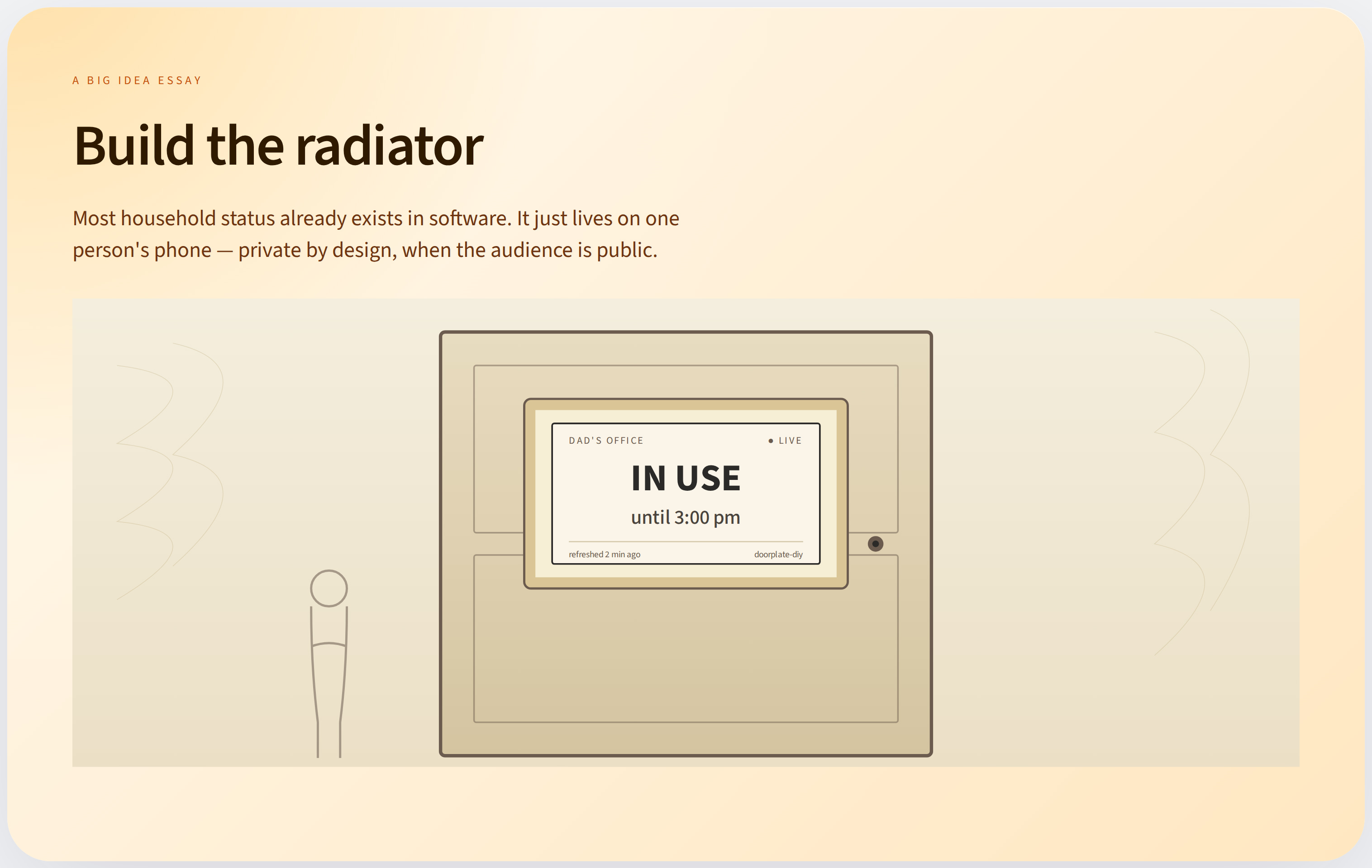
Hi, I’m Greg 👋! I write weekly product essays, including system “handshakes”, the expectations for workflow, and the jobs to be done for data. What is Data Operations? was the first post in the series.
This week’s toy: a copy of Lululemon, aimed at forcing social change for the makers of activeware.
Edition 300 of this newsletter is here - it’s April 20, 2026.
Thanks for reading! Let me know if there’s a topic you’d like me to cover.
The Big Idea
A short long-form essay about data things
⚙️ Build the info radiator
Every remote worker has the same problem. Somebody in your household (a kid, a spouse, a roommate) needs to know whether you’re in a meeting right now. The information exists on your calendar. But it’s trapped inside your phone, and your phone is the one device in the house that’s designed, from the ground up, to be private.
When my kids were little, they’d hover outside my office door and guess. Fifteen years of remote work has not improved the guessing game, and every remote worker I know has their own version: a partner who can’t tell whether the silence means “in flow” or “went for coffee,” a kid who needs to ask about a permission slip, a housemate with a package question.
When meetings were rare and scheduled in advance, it was easier to say “don’t bother me.” But meetings happen anytime; they move, they get added at 8:57 a.m., they run long.
You end up with a kid trained to be cautious hovering outside a door behind which you are, in fact, reading a meme post.
The phone is a privacy envelope
The real problem isn’t that status information doesn’t exist, it’s that it’s hard to share the outside of the envelope (your free/busy).
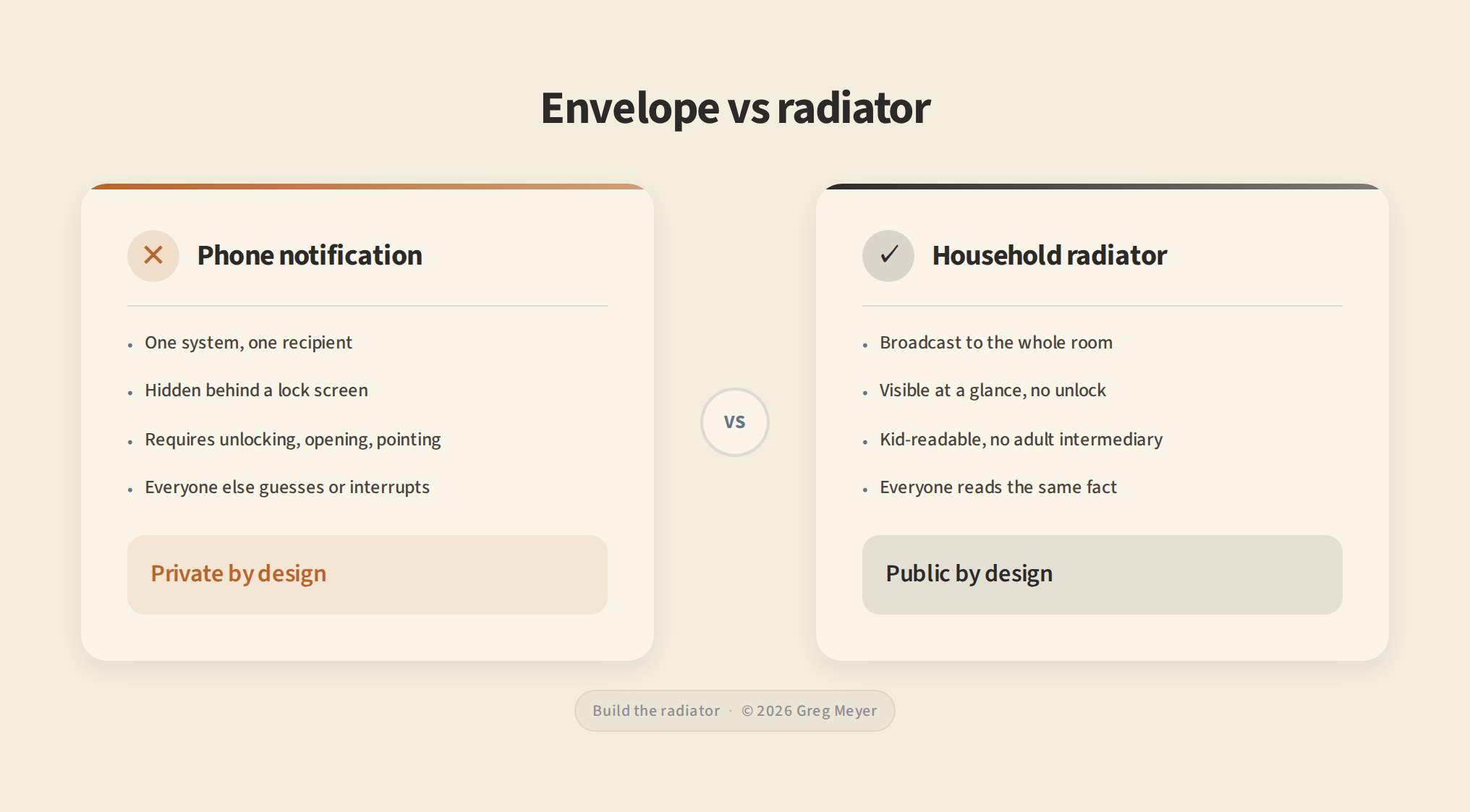
A phone notification is a message from one system to one person. The unlock screen exists specifically so your status and your calendar and your messages don’t leak into the room. That’s good when the recipient is one person.
It’s catastrophic when the recipient is everyone except you — the people in your house who need to read your status to decide whether to knock. Your calendar knows you’re busy. Your phone knows you’re busy. Nobody else in your house can read your status.
Public by design
The conference room solved this problem twenty years ago with a little card on the door that says AVAILABLE or IN USE. The status is public because the audience is public. Anyone walking down the hallway needs to be able to read it at a glance.
The placard puts the answer in the room, at eye level, in a form a kid can read, without anybody having to ask for permission or wait for an adult to surface the information.
Households need the same move for the same reason. Some pieces of information exist to be read by anyone who walks past, and those pieces don’t belong on any single person’s phone.
They belong on an object that the whole household can glance at the way they glance at a whiteboard, a calendar on the fridge, or a clock on the wall.
Alistair Cockburn, writing about agile teams in the early 2000s, called the office version of this an information radiator — a board or chart you couldn’t ignore because it was in the room you already walked through. Every household needs a few of those. The information doesn’t need to leave the phone for the phone’s own sake. It needs to leave the phone so the people who don’t own it can read it too.
The test is simple: if a piece of status in your house has to reach more than one person in the room, it belongs on an object, not a phone. Phone notifications are private by design. A radiator is public by design. Match the medium to the audience.
Once you start applying that test, you see the same shape of problem all over the house. Most of the small decisions a household makes in a given day turn on a digital input that someone has to remember to look up:
Should I knock on the door? → whatever’s on your calendar right now
What should the kids wear to school? → whatever the weather app says about the next six hours
What are we eating tonight? → whatever’s in the fridge, minus what’s about to expire, plus what’s already on the meal plan
In each case, the information exists and is boring for software to produce. In each case, it lives in an app on one person’s phone. Let’s change that.
Show the answer, not the inputs
A radiator isn’t useful because it moves data into the room. It’s useful because it moves a decision into the room.
Your brain is full. Every parent has a running count of small choices — jackets, lunches, who-needs-to-leave-by-when, whether to knock — and none of them are individually hard but collectively they are the entire reason you can’t remember what you walked into the kitchen for.
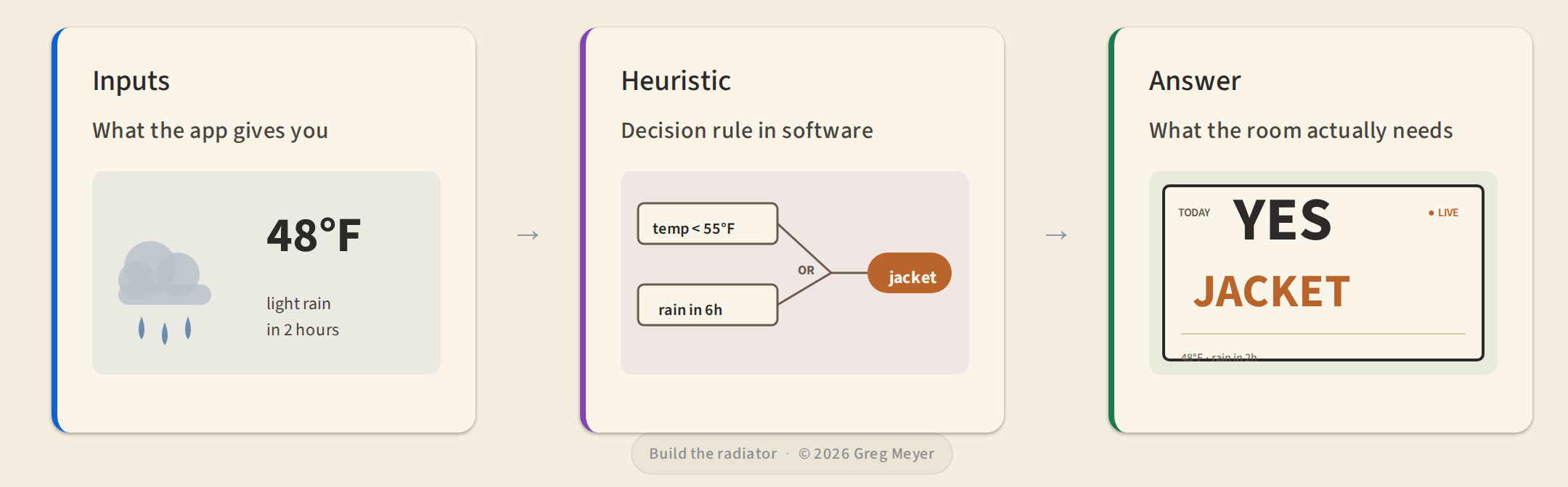
The reason the phone apps don’t help is that they don’t deliver decisions. They deliver raw inputs: 48°F, light rain in two hours, seventeen items in your fridge. You still have to run the heuristic in your head to get the answer.
The value of a radiator is that somebody — or some small piece of software — has already run the heuristic, and what lives in the room is the output. Not 48°F, light rain in two hours. YES JACKET. Not three meetings before 3 p.m. with gaps. IN USE UNTIL 3:00. Not leftovers, chicken breast, spinach, half a jar of pesto. TONIGHT: CHICKEN PESTO PASTA.
Heuristics belong in software. Decisions belong in rooms.
A note on the fridge, not a camera in the hallway
The last ten years of “smart home” have felt slightly off, and it’s not the technology — it’s the direction of the arrow. Nobody wants a camera in every room. Nobody wants a microphone listening for trigger words in the kitchen. All of those are the home watching you.
A radiator is the reverse: it’s the home telling you something you asked it to keep track of.
A sticky note on the fridge is friendly. A camera pointed at the fridge is creepy. They convey related information — the milk’s almost out — but one is a broadcast from a household to itself, and the other is a surveillance feed leaving the house. The radiator stays firmly on the sticky-note side.
Output-only. No microphones, no cameras, no presence sensors. It reads from sources you already own — your calendar, your weather, your meal plan — and it stays on your network. Nothing new is being collected; something existing is being surfaced to the room that needs it.
Ink, not light
Most “smart home” products also feel wrong for a simpler reason: they glow. A tablet in the hallway is a small sun. A wall-mounted iPad is a small sun. At 2 a.m. on a water-glass run, all of those are small suns in your eyes.
The radiator uses a paper-like display on purpose. It holds its image without power, so it’s dark unless there’s light in the room — exactly like a sticky note or a printed calendar. It doesn’t pulse, doesn’t notify, doesn’t beg for attention.
You glance, you read, you keep walking. A household has finite tolerance for glowing things, and most of it is already spent on phones and televisions. A new object in the house that adds zero additional glow is an object the house will actually accept.
The proof of concept
I built one of these information radiators. It’s called doorplate-diy, the software is open source, and it costs about $50 to build it yourself.
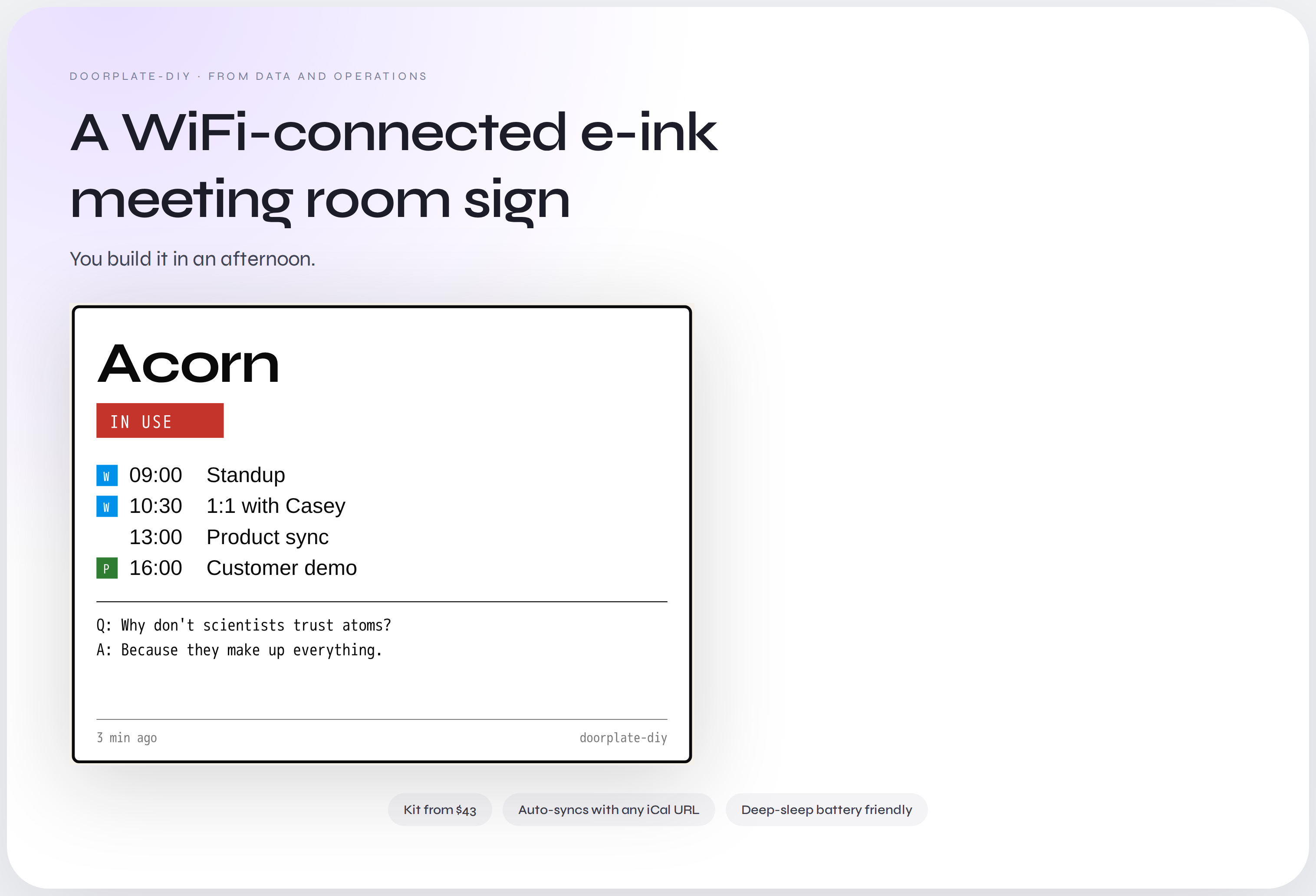
The Doorplate uses a color e-Ink display, a small board that drives it, a USB-C cable or battery, and a picture frame (you can use one from IKEA if you like.) To mount it, you pop out the paper insert, drop in the panel, and hang it on the door.
The device runs about a month on a small battery, or forever if you plug it into the wall. The server that feeds it runs on the Mac you already own; the sign checks in every fifteen minutes and goes back to sleep. No cloud account, no subscription, no data leaving the house.
When it’s done, you have an object on your door to display if you’re busy. (Or you could use it for other reasons, but that’s the first one.)

Public by design, answers not inputs, output-only, paper not light — those four rules apply cleanly to each one. I’ve shipped a door sign that solves the “is Dad on a meeting” problem for my household.
Pick one
If you have a piece of household information that everyone except one person has to guess at — whether you’re on a meeting, what to wear to school, what’s for dinner, whether the kid is allowed downstairs yet — pick the one that irritates you most, and make it public.
Everything else is the same principle applied to a different room: the information isn’t missing, it’s just in the wrong place. Take it out of the envelope. Hand it to the house.
Build the radiator.
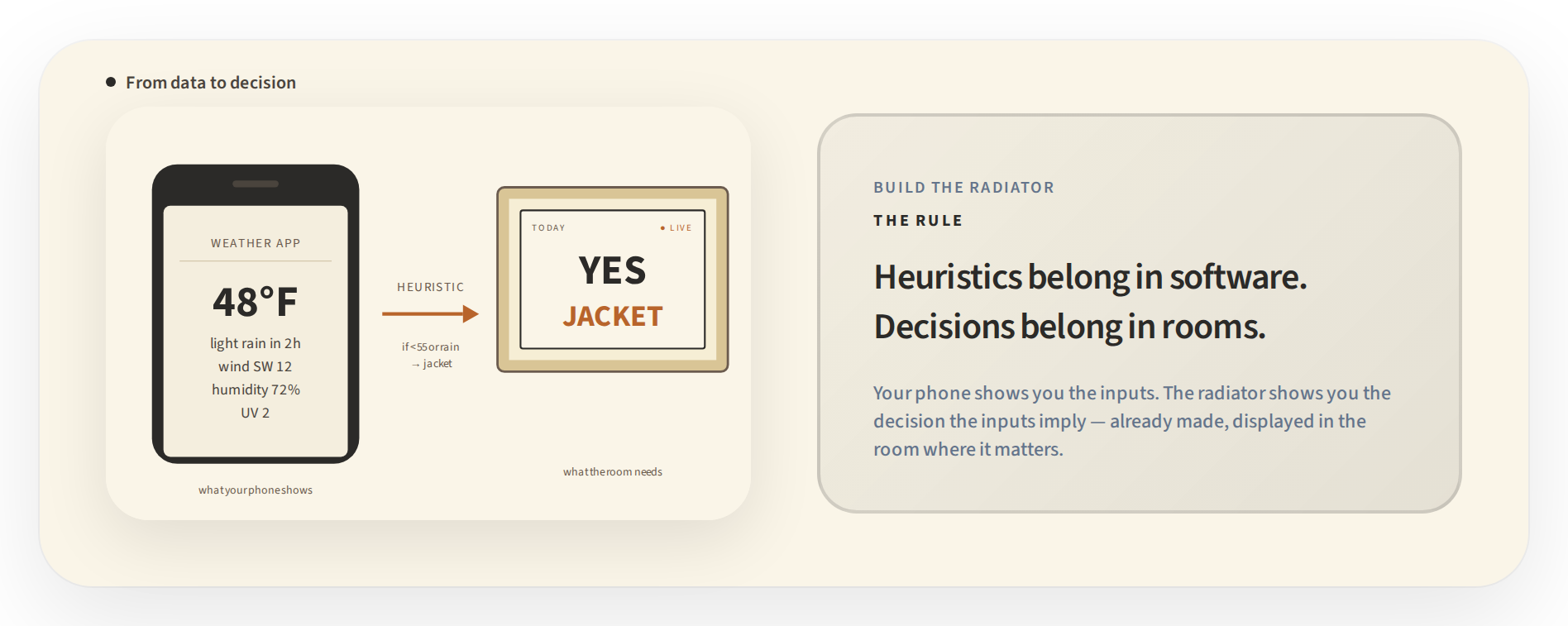
What’s the takeaway? The test is simple: if a piece of household status has to reach more than one person in the room, it belongs on an object, not a phone. The doorplate example is one idea … you could build more.
Links for Reading and Sharing
These are links that caught my 👀
1/ Fridge Magnets and Memory - As a collector of fridge magnets, I endorse this essay on how they remind us of times past (and some imaginary). Also, reading it taught me some new things about magnets.
2/ Posthog on Agents - The team at Posthog wrote this great piece on agents. Are you building Command Line Interfaces or MCP servers? It turns out agents need them both: the first to make sure they have discrete triggers and actions to call and the second to provide token-efficient surfaces to decide which CLI function to use.
3/ How do Claude PMs think about being a PM - Life as a PM in the age of Claude.
What to do next
Hit reply if you’ve got links to share, data stories, or want to say hello.