


Hi, I’m Greg 👋! I write weekly product essays, including system “handshakes”, the expectations for workflow, and the jobs to be done for data. What is Data Operations? was the first post in the series.
This week’s toy: if you keep your grocery receipts for 25 years, you too can create a data visualization of the change in the price of eggs over time. (AI can read bad thermal paper receipts, apparently.)
Edition 297 of this newsletter is here - it’s March 26, 2026.
Thanks for reading! Let me know if there’s a topic you’d like me to cover.
The Big Idea
A short long-form essay about data things
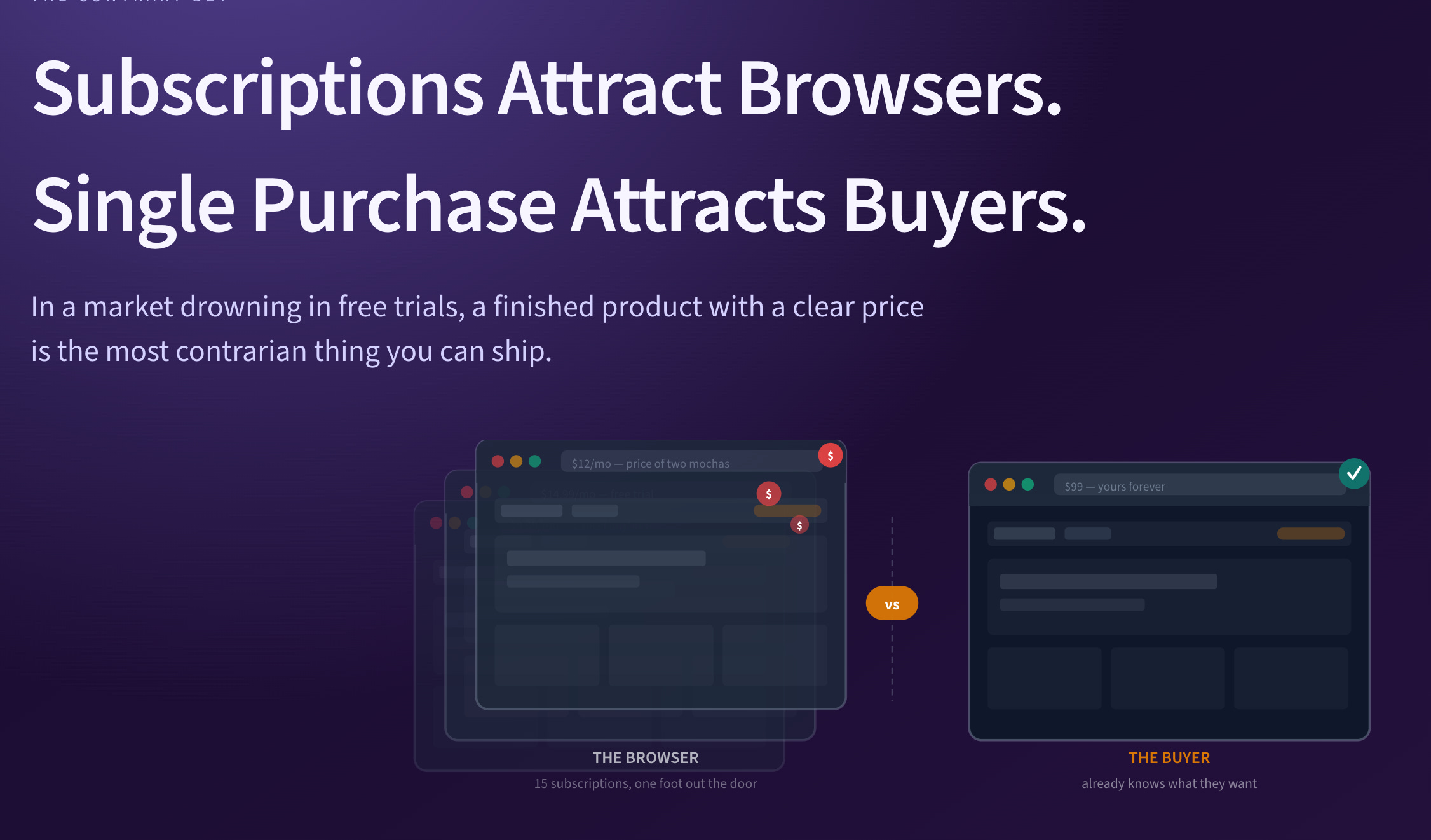
⚙️ Subscriptions Attract Browsers. Single Purchase Attracts Buyers.
When you buy your next speaker, are you going to grab whatever Bluetooth is on sale at Best Buy? Or are you going to find the right great-sounding speaker that fits into your current system, like a Sonos Roam?
That question tells you more about pricing strategy than most business books.
The person grabbing the sale speaker is browsing. The Sonos buyer already has a system, already knows what good sounds like, and is completing a setup, not starting one. They are different people with different intent, and they respond to completely different signals.
I think about this a lot right now because the software market is in a weird place. Three forces are pulling buyers in different directions, and the default response from most founders — monthly subscription, free trial, pray for retention — is getting weaker by the quarter.
The subscription model trained buyers to leave
Everyone has a subscription they forgot to cancel.
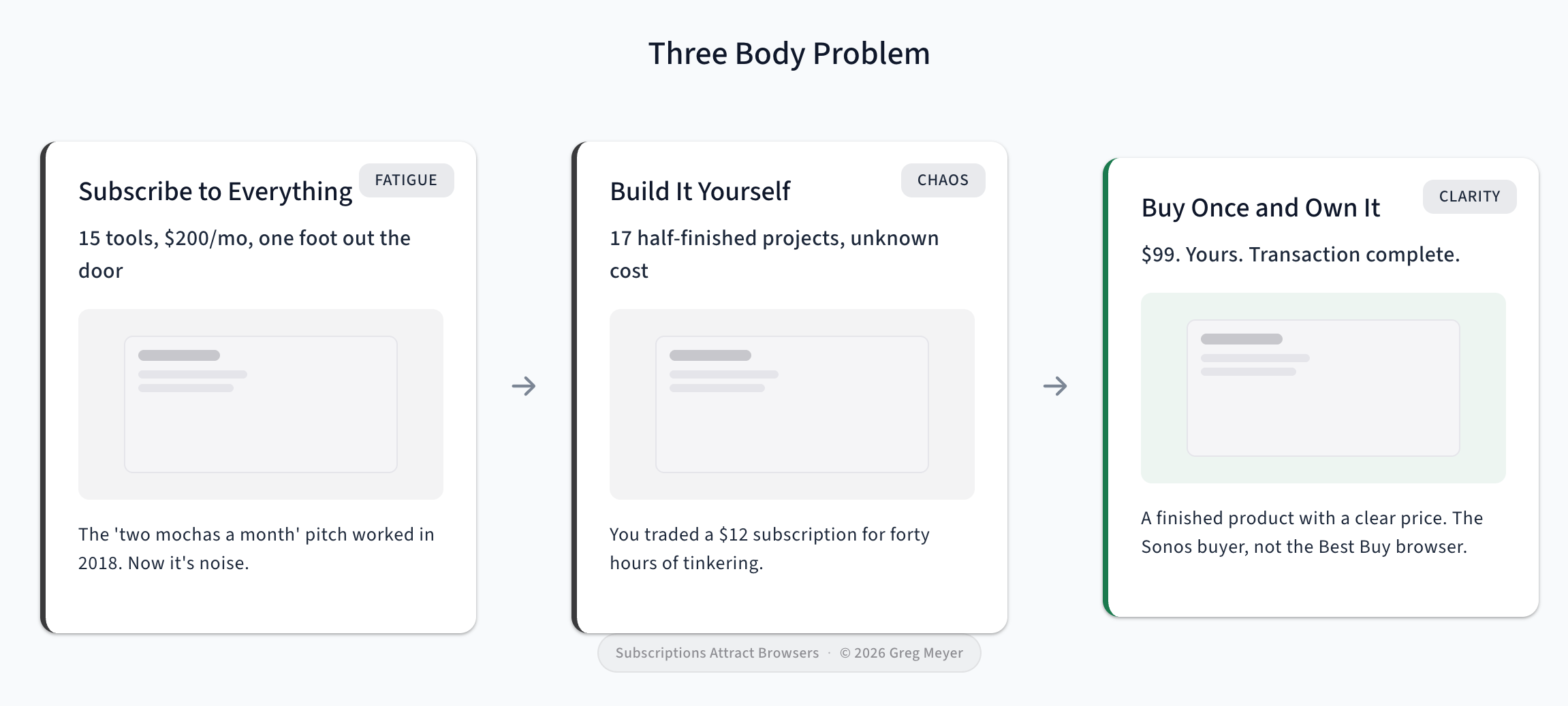
You open your credit card statement and there it is. $14.99 for something you used twice in January. The pitch was “the price of two mochas a month.” That framing worked in 2018 when you had three subscriptions. It stops working when you have fifteen.
This is not anecdotal. Kyle Poyar’s 2025 SaaS Benchmarks report covering 800 companies found median net revenue retention of just 82% for B2B SaaS and 49% for B2C. More than half of consumer subscription revenue evaporates every year. Recurly’s benchmark data across 1,200+ subscription sites shows average monthly churn of 3.5 - 6.5% depending on industry.
The model itself trained people to keep one foot out the door.
When “cancel anytime” is the primary selling point, people cancel.
I ran a GTM ops team where we spent more time analyzing churn cohorts and building win-back sequences than we spent on the actual product experience. That felt like a miss.
The vibe-coding escape route
There is a second force reshaping how people think about buying software, and it has nothing to do with pricing pages.
AI changed the build-versus-buy math.
Two years ago, if you needed a tool to manage your client pipeline or track your content calendar, you had two real options:
find a SaaS product that was close enough,
or hire someone to build what you actually wanted.
Option one meant a subscription. Option two meant real money and real time.
Now there is a third option. Open a chat window, describe what you need, and start building. You can build your exact use case, your exact workflow, no monthly fee, no compromises.
The reality is a lot messier. I have several half-finished projects that do not quite solve the problem as well as the $12/month tool I was annoyed to pay for but that at least actually worked.
The cost of vibe coding is not tokens: it is the slow accumulation of unfinished things. Each time you feel really close to finishing, but the last 10-20% in software is really hard to make it complete enough for other people to rely on. You trade a $12 subscription for forty hours of tinkering and a prototype that breaks when you change one input.
This is build fatigue, resulting from having infinite capability and no finished product.
What single purchase actually does
I keep coming back to single purchase, because it provides a middle ground between subscriptions and vibe coding.
On one side: subscription noise. Fifteen tools, monthly charges, cancel-anytime anxiety, and the quiet guilt of paying for things you barely use.
On the other side: the vibe-coding wilderness. Infinite possibility, unknown time cost, and a growing pile of almost-done projects.
There is an opening for someone selling a finished thing at a clear price.
No recurring charge. No half-built prototype. No “price of two mochas” pitch. Just an exchange: money for a tool that works. You own it. Done.
This is not nostalgia for pre-SaaS software. It is a filtering mechanism.
Go back to the speakers. The person who grabs the $19 Bluetooth at Best Buy is not the same person who buys a Sonos Roam. The Sonos buyer already has a system. They are not browsing — they are completing something. Single purchase selects for that buyer.
The person who pays $99 once already knows what they need because they already understand the value.
That is not a smaller market. That is a better market.
The math, briefly
A $99 one-time purchase with a 3% conversion rate on a thousand visitors produces $2,970.
A $10/month subscription with a 1% conversion rate and four-month average retention produces $400 from the same traffic.
The subscription theoretically wins at scale with strong retention. But “strong retention” is doing a lot of heavy lifting in that sentence, and Poyar’s data shows most products never get there.
The more interesting difference is not revenue per visitor. It is who shows up.
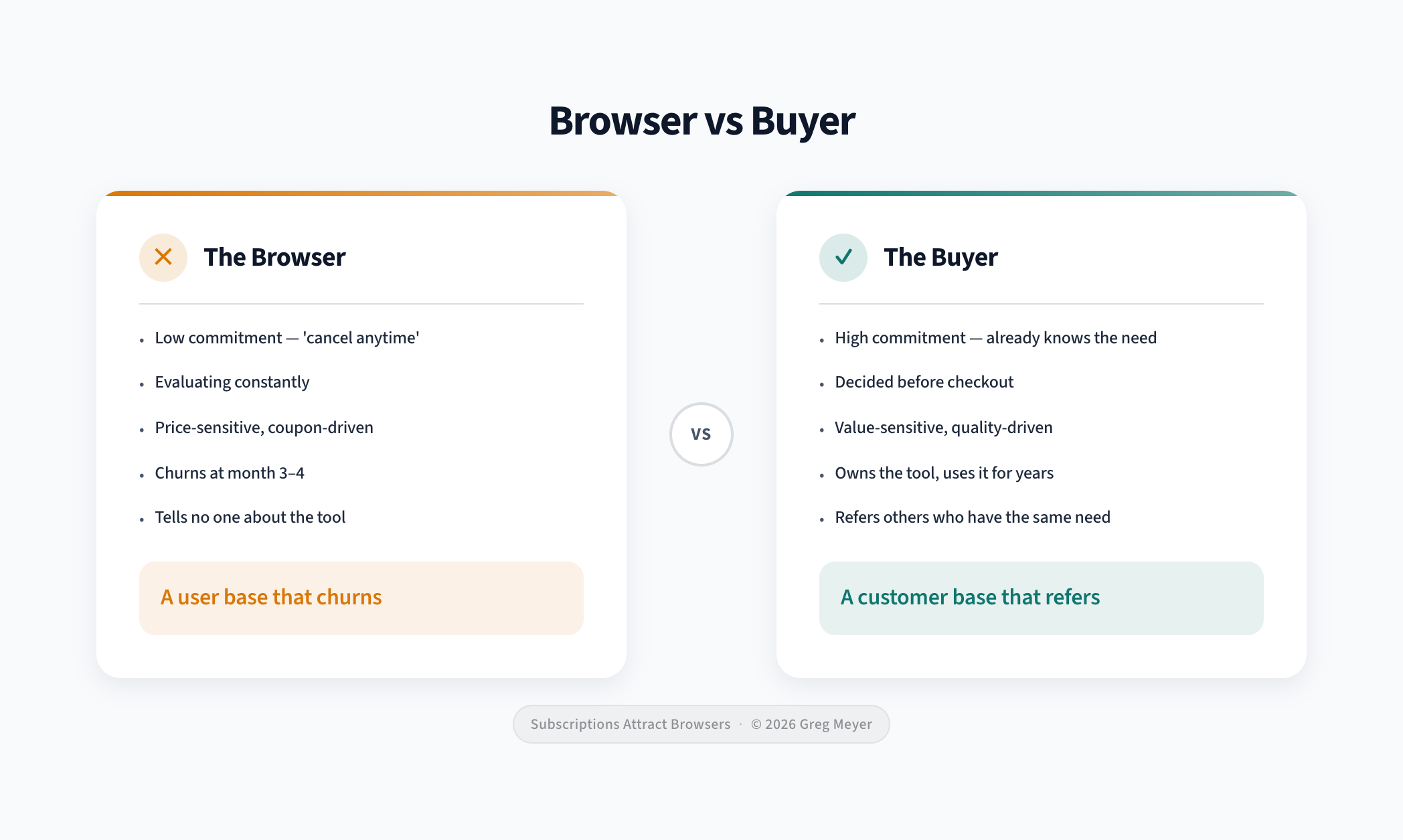
Subscription attracts people who are willing to try. Single purchase attracts people who are ready to buy. Those produce fundamentally different businesses. One gives you a user base that churns. The other gives you a customer base that refers.
The contrary signal
In a market where every competitor races to $0 trials and $9/month plans, charging once and charging well sends a specific signal.
It says: this is finished. This is not a beta you are paying to test. This is not a feature set that will get paywalled next quarter. This is a tool, it works, and it is yours.
Free trials are invisible now. They are table stakes that stopped differentiating years ago. But “no subscription required” still stops people.
It creates a moment where the buyer pauses and thinks: wait, I just pay once?That pause is worth more than a thousand optimized onboarding flows. For a growing category of tools — the ones that do a specific thing well, that live locally, that solve a bounded problem — the contrary bet is worth making.
Charge enough that it means something. Let the price point filter for the customers who actually want what you built.
What’s the takeaway? In the land of vibe coding and subscription fatigue, the Sonos buyer is out there. They are tired of browsing. Build them something worth owning.
Links for Reading and Sharing
These are links that caught my 👀
1/ The agent thing is a big deal - When industry analysts remain impressed, you know that a tech trend is real. Ben Thompson is a skeptic, and believes in the power of AI agents. (ps, he’s right.)
2/ What’s up with the job market? - Wondering which way the job market will go with the advent of AI? Me too. Andrej Karpathy has created a data visualization of jobs most likely to be displaced or changed by AI.
3/ Money money … - The best way to sustain a business? Capture the nostalgia of a pop wave like ABBA. It will keep going long after they are gone.
What to do next
Hit reply if you’ve got links to share, data stories, or want to say hello.