


Hi, I’m Greg 👋! I write weekly product essays, including system “handshakes”, the expectations for workflow, and the jobs to be done for data. What is Data Operations? was the first post in the series.
This week’s toy: Commodore (yes, that Commodore) made a Dumb Phone. It’s a flip phone that has limited access to the kind of apps you would want in your smartphone, but feels like a trip in the wayback machine back to a land before the iPhone.
Edition 307 of this newsletter is here - it’s July 27, 2026.
Thanks for reading! Let me know if there’s a topic you’d like me to cover.
The Big Idea
A short long-form essay about data things
⚙️ The atomic unit of organizational learning
What job is an operating update actually supposed to perform? We usually assume the answer is obvious and that the update reports project status only. That assumption might not be right, and points us at one reason why we’re bad at sharing updates.
Project status is real … but it’s almost like digital exhaust from the actual work being done. One person might spend five minutes before the meeting jotting down what comes to mind, or cutting and pasting the previous meeting’s update. Another person might have a complicated process for arriving at an update simple enough to share.
When an update works, it helps the organization learn whether a project is going well, sideways, or needing help. Telling the story of what we thought would happen, what’s actually happening, and what might need to happen to change course can be complicated.
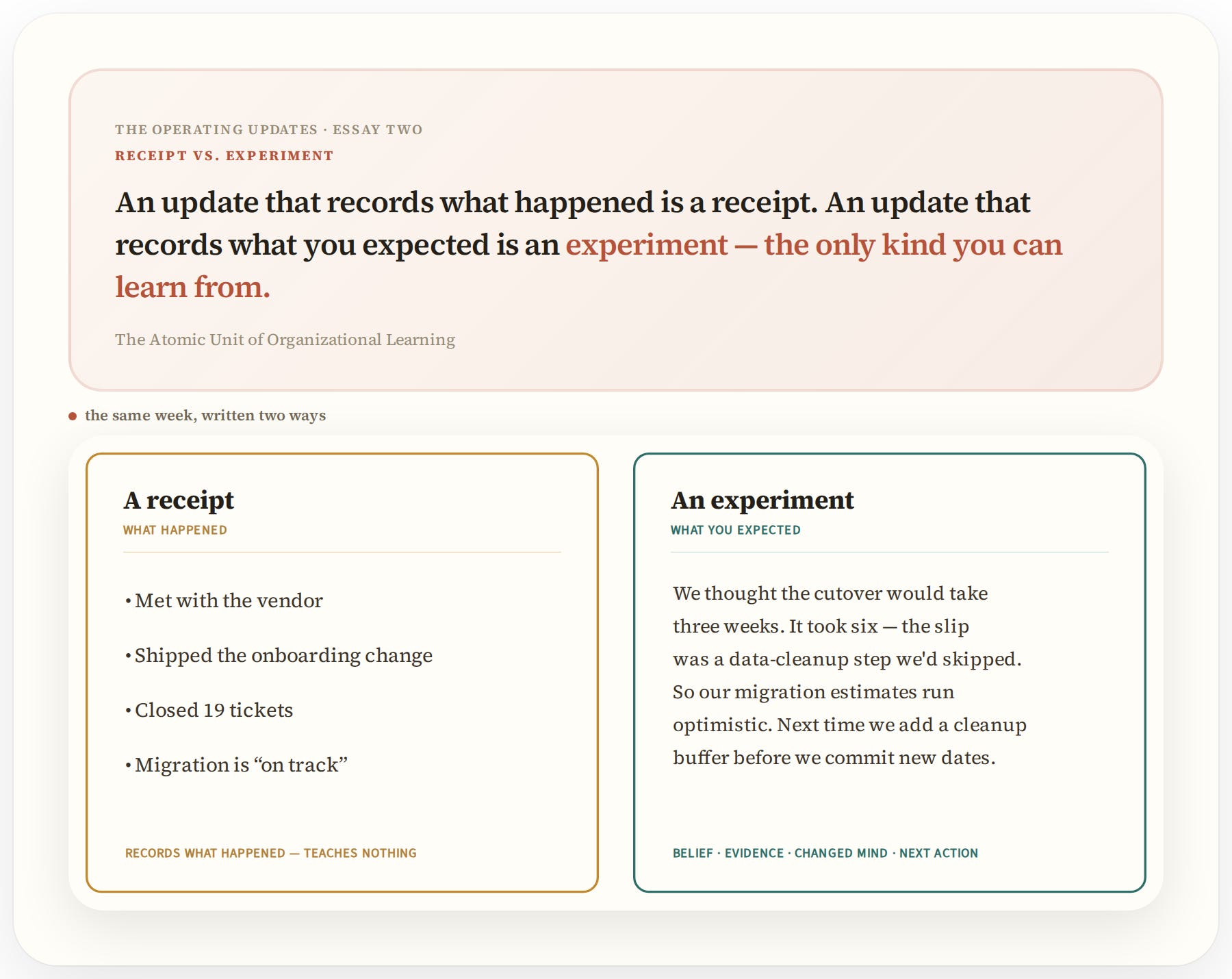
Normal updates don’t clear that bar, so what can we do about that? A default update doesn’t help you learn anything, and simply lists what happened:
we met with the vendor
we shipped the onboarding change
we closed 19 tickets
the migration is “on track”
That activity (think of it as “receipts”) tells you that something happened and doesn’t orient you to the value of the outcome. Simple activity reporting doesn’t tell you whether completing that activity was a high value activity.
What changed, by when, and what did it mean? That’s what you need to be asking yourself, especially when it’s someone else reading your update who doesn’t have the same context you do.
What would make a status update worth reading?
An update that behaves like an experiment would be a quality alternative to the current way we craft updates.
An experiment starts with a belief:
we think this change will lift activation
we expect the migration to take three weeks
we’re betting mid-market churn is a pricing problem and not a product one
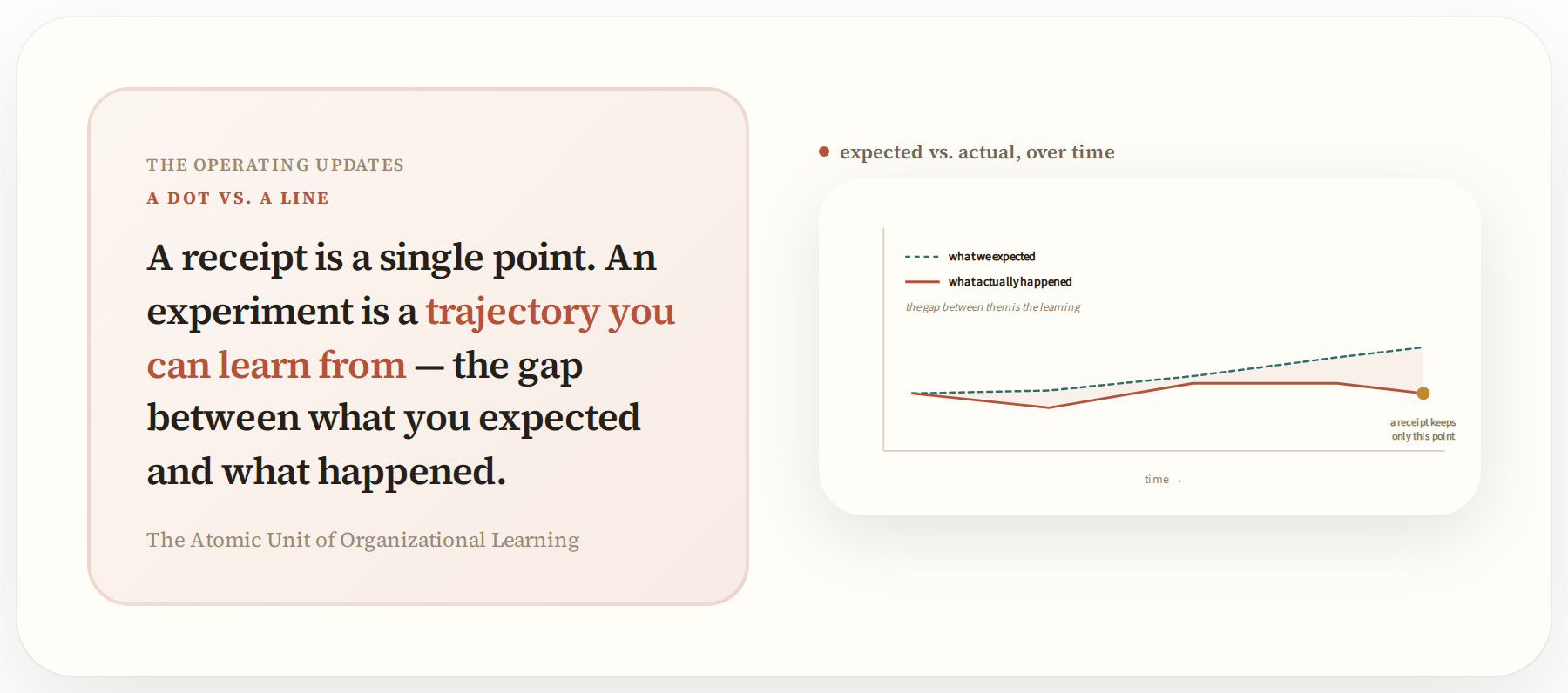
Then you write down what actually happened and put the two side by side.
This version of an update can teach you something because it shows you the parallel path toward reaching (or not reaching) a guess you committed to and tried to reach.
The bonus? Your updates now have a trajectory, demonstrating the rate of change over time. You can’t show that line with a simple update very easily. Writing down that expectation means you set a bet that you can be wrong about later - it’s a bit scary, and also easier for others to see when you’re hitting the mark or when you are off track.
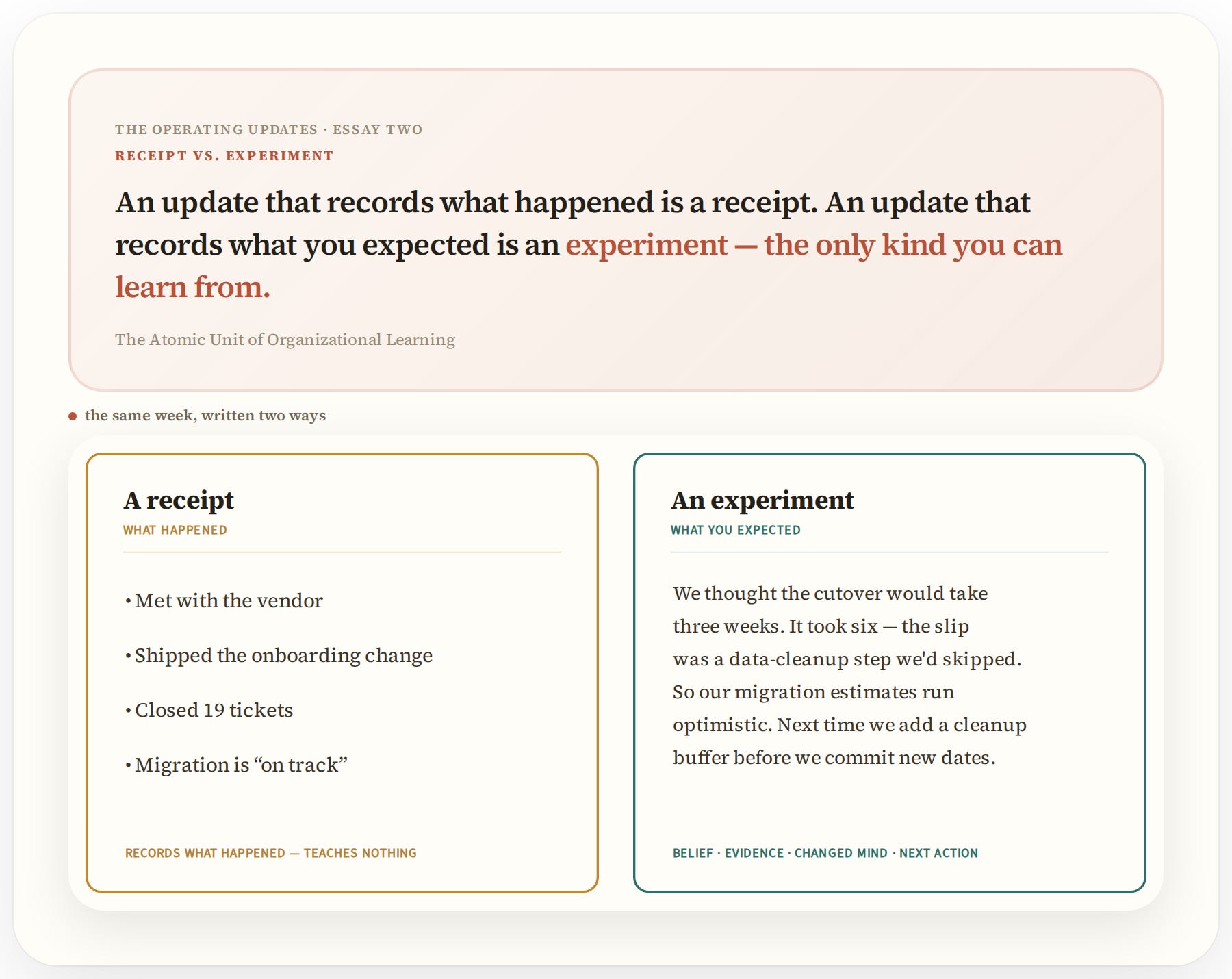
An update that only records what happened is a receipt. An update that records what you expected is an experiment. An experiment is the only kind you can actually learn from.
If we posit that an operating update is the atomic unit of organizational learning, we have a reason to improve that update. A metric is smaller than an update, but a metric without context (”activation rose 4 points”) is hard to evaluate. A dashboard (a compilation of metrics) without a decoder key is a wall of numbers.
We’re trying to avoid surprise when we deliver updates based on numbers and text boiled down to the smallest provable facts. But surprise is often where real organizational learning happens — and a receipt makes sure it arrives too late.
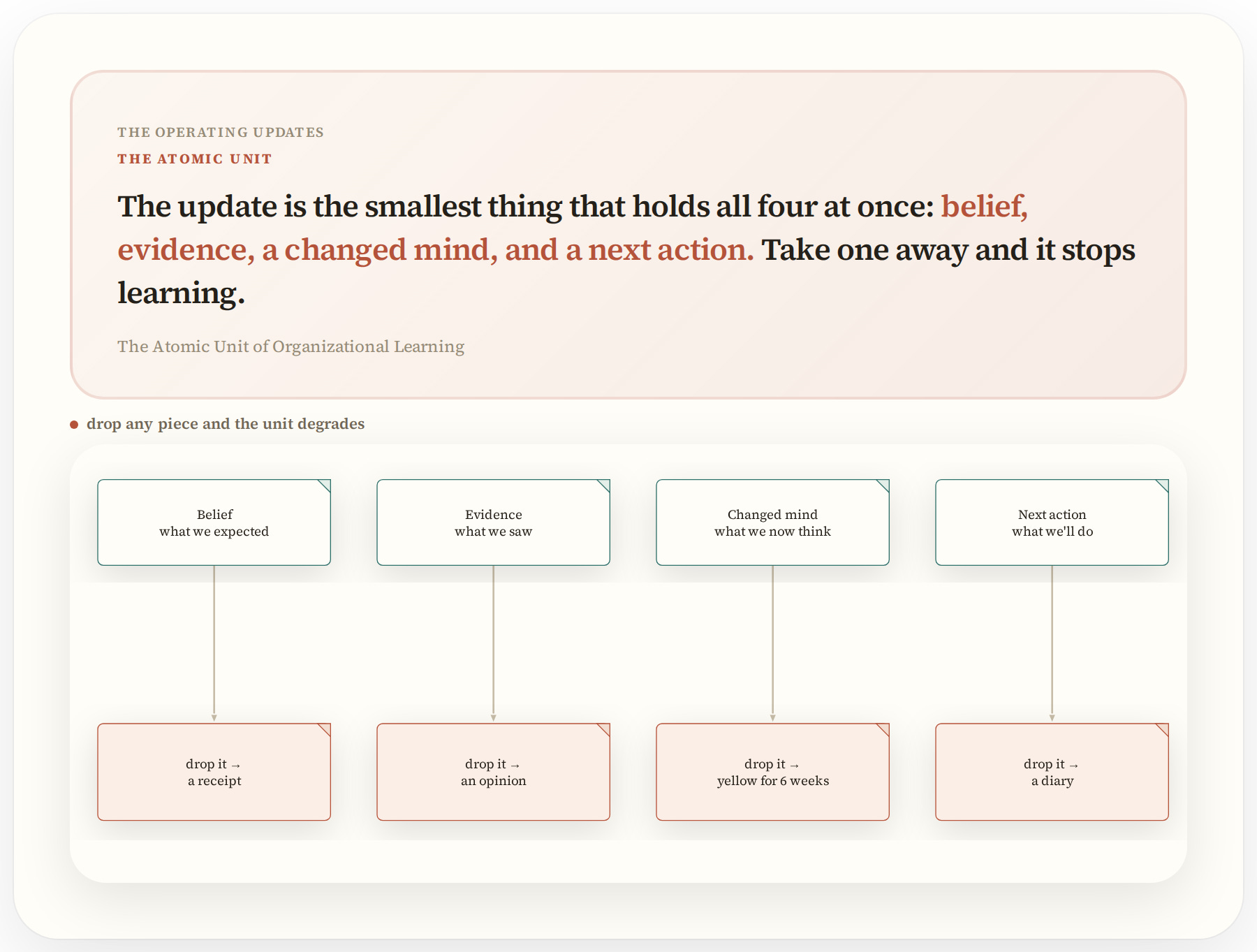
The update is the smallest thing that still holds all four pieces at once: what we believed, what we saw, how our mind changed, and what we’ll do next.
Take any one of these items away and you impede organizational learning.
Drop the belief and you have a receipt
Drop the evidence and you have an opinion.
Drop the changed mind and you have a status light that’s been yellow for six weeks.
Drop the next action and you have a diary.
It helps to see all four of these facets survive in one place.
The better update might look like this:
We thought the cutover would take three weeks, and it took six. The whole slip came from a data-cleanup step we’d waved past in planning. We now believe our migration estimates are systematically optimistic, because we price the happy path and never the mess. We’ve made a change to add a cleanup buffer before we commit dates on the next two.
That update is four sentences long, and it made the team permanently better at something it will do again.
The receipt version (“migration complete, thanks all”) took the same effort to write and didn’t make the organization better.
Once you see updates this way, there’s an uncomfortable conclusion.
If the update is the atomic unit of learning, then the quality of your updates sets the ceiling on how fast your organization can learn. Not how fast it works, but how fast it learns, which is the part that compounds.
An organization can’t out-learn the artifact it uses to compound learning.
When this change doesn’t happen, you can feel it in the organizational “swirl” or “busyness.” Companies can feel busy and stuck at the same time. They ship constantly, review constantly, and still argue the same questions they argued a year ago, because none of that motion ever got written down in a form that could settle anything.
Effort is visible in activity updates. Understanding isn’t always evident.
The problem with operating updates was never that they’re badly written, or that some people have a knack the rest of us don’t. It’s that most of them were never built to drive learning.
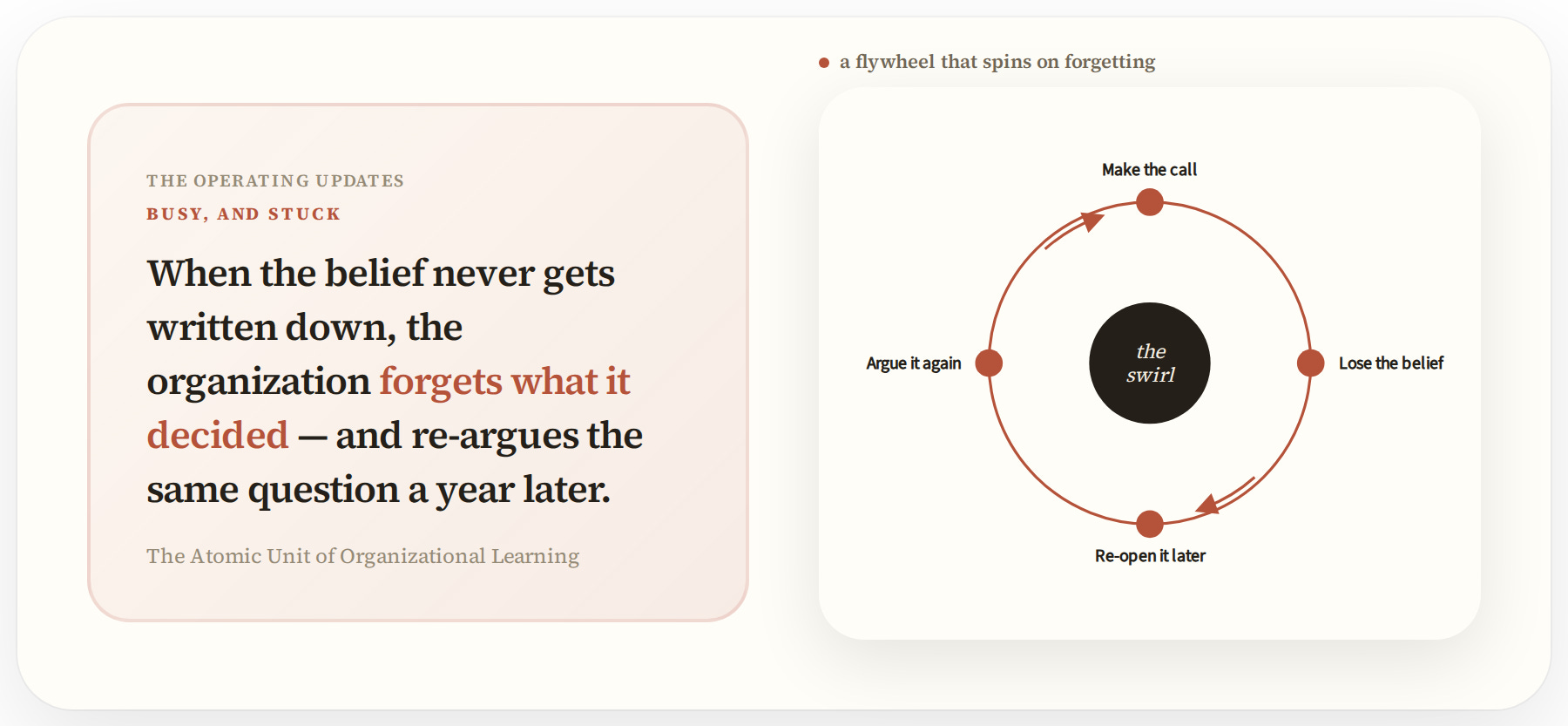
If the update is how organizations learn, and any experienced operator can feel the difference between a receipt and an experiment in seconds, then companies should be getting steadily smarter about their own work.
But they mostly don’t. They reopen decisions they already made, lose predictions they were once sure about, and rediscover old conclusions like they’re new.
That in-process forgetting is stranger than it looks. History rhymes rather than repeating exactly, so the moment we’re re-deciding never looks quite like the last one. The updates are all sitting in the archive, searchable. But what we lose isn’t the record. We lose the change over time, and what we actually learned because of it.
We hold the unit of learning in our hands every week.
So why are we so good at forgetting?
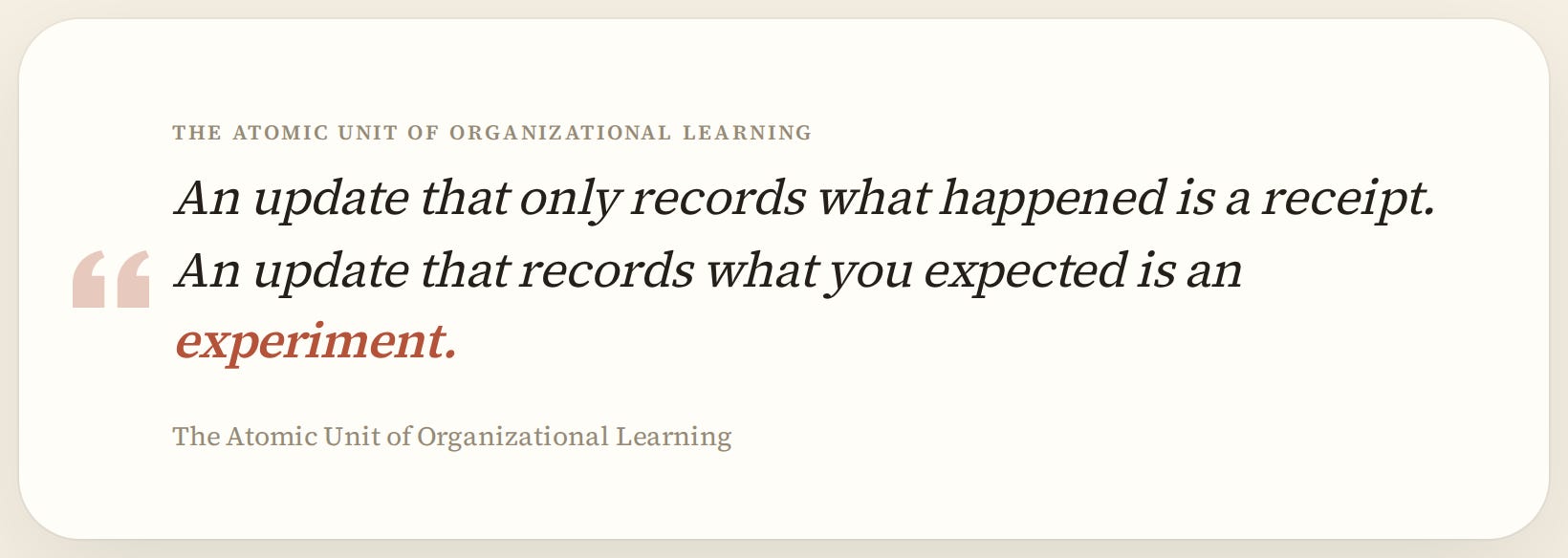
What’s the takeaway? The operating update is the atomic unit of organizational learning. It’s the smallest thing that still holds a belief, the evidence, a changed mind, and a next action. Most updates are receipts: honest records of what happened that can't teach anyone anything.
Record what you expected instead, and the update becomes an experiment for learning. Because it's the unit your organization learns through, the quality of your updates sets the ceiling on how fast the whole company can learn.
Links for Reading and Sharing
These are links that caught my 👀
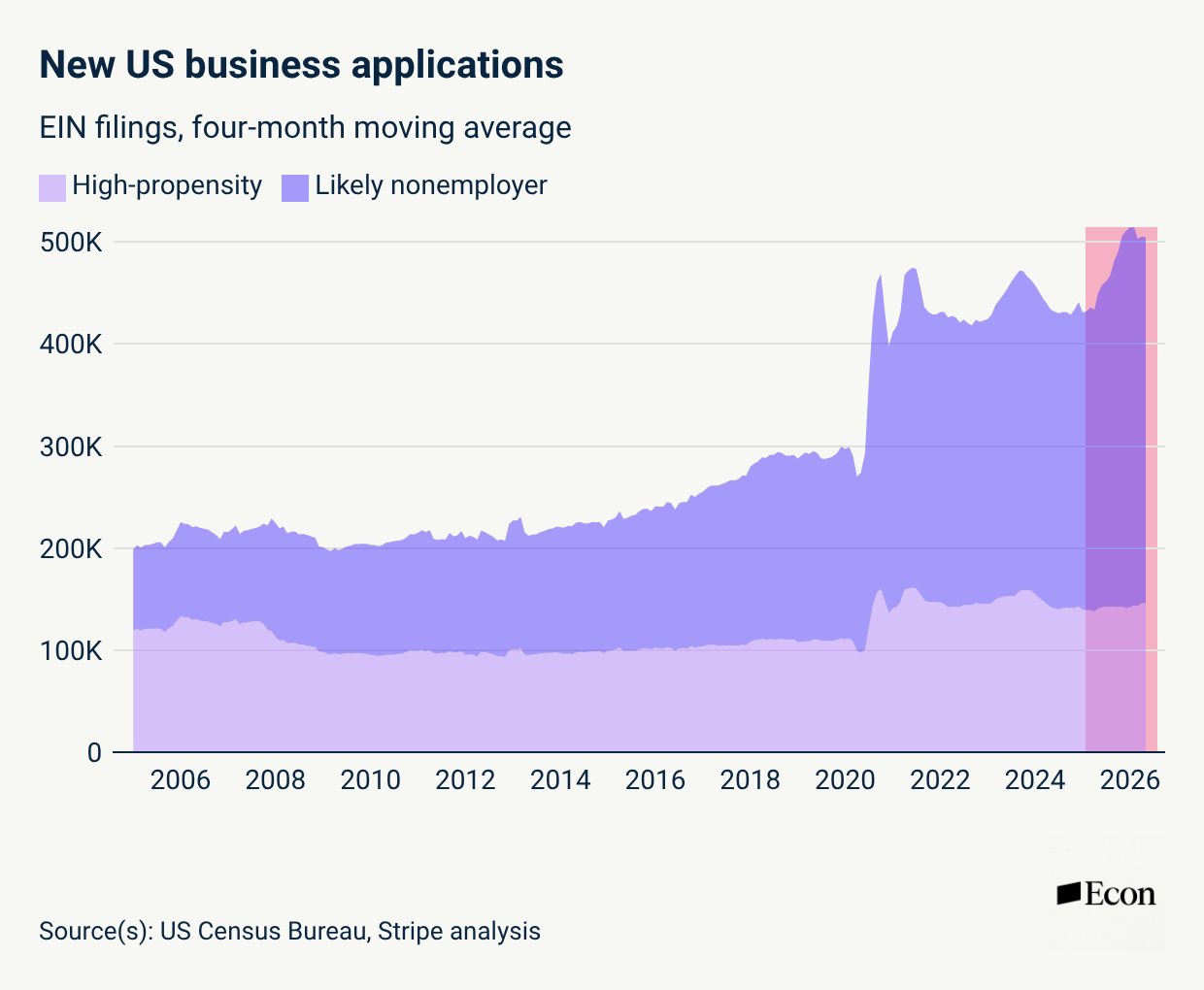
1/ The age of the solopreneur - Unless you’ve been under a rock, it’s more evident than ever that your next business might need to be one you set up yourself. Stripe is leading the way in thinking and writing about this trend.
2/ Claude gets more tools - Claude Artifacts are gaining more of the attributes of a true application. They now have sharing, connectors, and visualization. It doesn’t seem like they are too far away from “launch your Claude app in a private Cloud” or “Run your app on Claude.”
3/ Qwen builds Images - These models are getting really good.
What to do next
Hit reply if you’ve got links to share, data stories, or want to say hello.