


Hi, I’m Greg 👋! I write weekly product essays, including system “handshakes”, the expectations for workflow, and the jobs to be done for data. What is Data Operations? was the first post in the series.
This week’s toy: a functional LEGO keyboard brick that’s a computer. If you remember the single bricks that showed a '"computer” this is a scaled implementation of that idea: a real computer in the shape of a square LEGO brick with a slanted front. Edition 296 of this newsletter is here - it’s March 16, 2026.
Thanks for reading! Let me know if there’s a topic you’d like me to cover.
The Big Idea
A short long-form essay about data things
⚙️ You’re using AI wrong

I asked a friend this week what he was building with AI.
“I’m doing some pretty interesting things with ChatGPT,” he said.
I waited for the rest of the sentence, and there wasn’t anything else.
He meant he was searching. Asking questions, getting answers, maybe summarizing an article. He was using a large language model the same way he used Google in 2015, just with better grammar on the output side.
twiI am pretty sure most of the American public believes that “using AI” means typing questions into ChatGPT or Claude and getting slightly better search results. If they are really advanced, they have customized a chatbot to give domain-specific answers, or connected it to their email so it can surface calendar conflicts.
That is not using AI. That is using a chat window.
The local maximum
We’re all used to hearing a message: AI equals chatbot. A chatbot is an application focused on chatting.
So people chat. They ask questions. They get answers. They move on.
What they don’t realize is that behind that chat window sits a system that can help you create software, invent new document formats, build internal tools, generate curriculum for almost any skill, and co-author things that would have taken a team of specialists a year ago.
This is a failure of imagination, not intelligence. People are not dumb, they just don’t have good context for what is possible. When the only frame you have been given is a text box that answers questions, you ask questions.
You do not think to ask it to build you a personal CRM, design a reading tracker, or generate a custom invoice system for your freelance business. (And you should!)

So what do you do when you find a friend who wants to learn more about AI but does not know where to start?
You help them build one thing, while they drive the experience.
The problem is the blank page. My friend doesn’t know the unknown task of creating the software. And this is the gap that pauses most people.
They open ChatGPT, stare at the prompt box, and type “help me build an app.” The response they get is too generic to be useful and too long to be actionable. They close the tab.
What they need is not a better prompt. They need a first move.
LEGO bricks, not magic
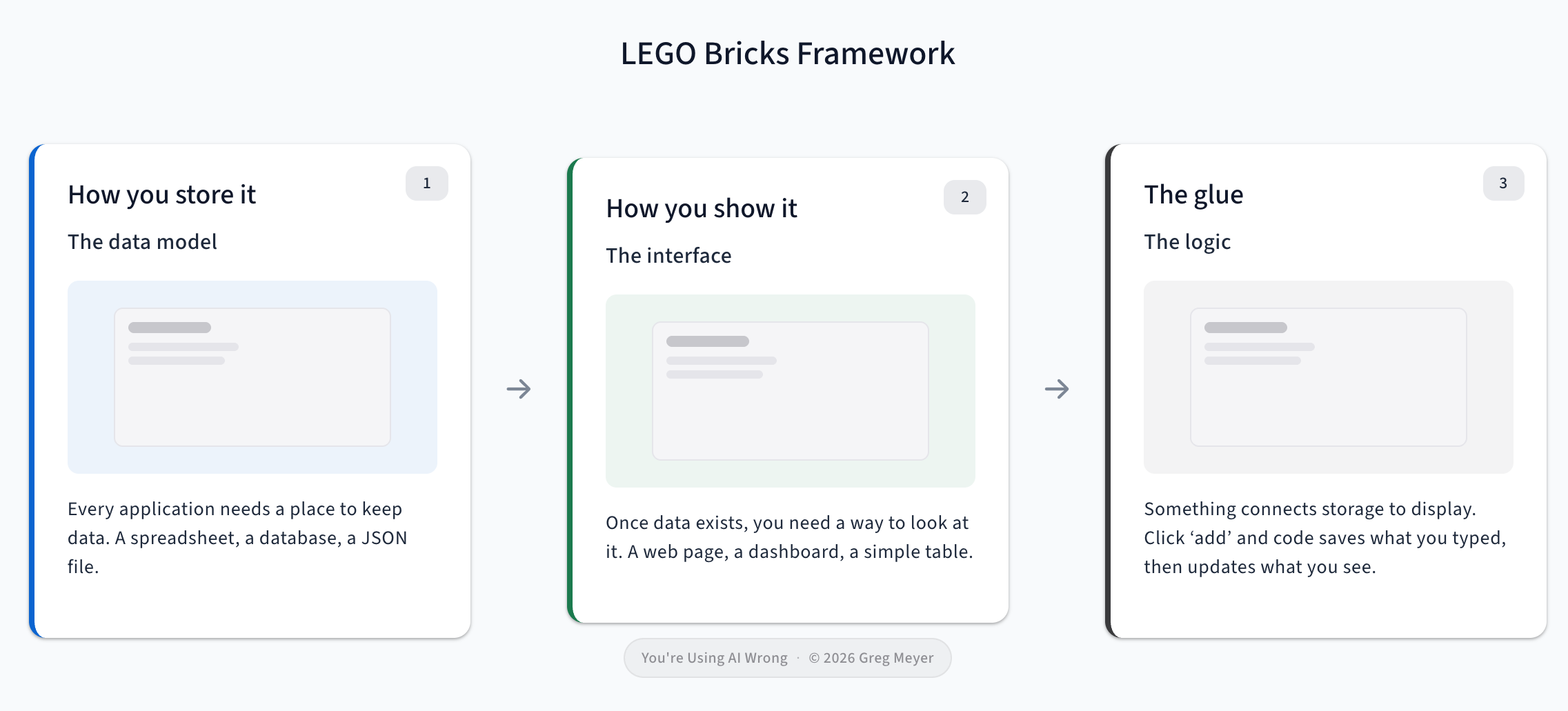
The best builders I have worked with share one trait. They get really good at identifying what I call the LEGO bricks.
These are the key building blocks that every piece of software is made of:
How you store it. Every application needs a place to keep data. A spreadsheet, a database, a JSON file. When your friend says “I want to track my reading list,” the first LEGO brick is: where does the list live?
How you show it. Once data exists, you need a way to look at it. A web page, a dashboard, a simple table. This is the interface, the thing a person actually sees and touches.
The glue. Something has to connect storage to display. When a user clicks “add book,” code runs that takes what they typed, saves it, and updates what they see. That is the glue.
A reading tracker and a billion-dollar SaaS product have the same bones. The complexity changes, but the structure doesn’t change all that much. (Yes, I know enterprise software is different, but this is a persuasive essay to convince people to build.)
When your friend understands these three building blocks, the blank page gets smaller. Instead of “build me an app,” they can say: “I need to store a list of books with title and rating, show them in a simple table, and let me add new ones.”
Controlled obsession is the fuel
But knowing the LEGO bricks is not enough. Your friend needs a reason to push through the friction.
I have written before about controlled obsession as the bottleneck for building — Ben Basche does it better. The idea is simple: if you are building something because you cannot stop thinking about it, you will find a way through the hard parts. If you are building because someone told you AI is important, you will quit at the first error message.
The friend who wants to learn AI does not need a tutorial. He needs a problem he personally cares about solving. Maybe it is tracking his kid’s soccer stats. Maybe it is organizing recipes his grandmother wrote on index cards. Maybe it is building a tool that helps him prep for client meetings faster.
It does not matter what your friend wants to build. It matters that he cares enough to sit with the discomfort of not knowing what he is doing for longer than twenty minutes.
AI can co-build a lot of things with you. That does not mean it will be easy. It means the hard part moved. The hard part is no longer writing code.
The hard part is knowing what you want and being willing to iterate until you get it.
The tools are not ready yet (and that is OK)
Here is the honest truth: the current tools are in a weird middle state.
Claude Cowork might be the bridge for someone who has never developed software. It tries to make building possible without requiring you to know what a function is or how a database works.
But Claude Cowork misses something important. It cannot do everything for you. You end up in a state that is not quite development and not quite a magic wizard. You still need to make decisions about structure, fix things when they break, and understand enough to know when the output is wrong.
Codex has the same gap from a different angle. It is powerful, but it assumes you already know how to think like a developer.
What is coming next, I think, is a layer of software that interviews you first. It asks what you are trying to build, why, for whom, and what constraints matter. Then it composes the interface you actually need to build the thing.
We’re describing software that builds the tool that builds your software. But it would cover the full spectrum of developers from noob to expert.

The real gap
You might be using the tool wrong, but only because no one showed you what it can do.
The gap is not intelligence, it is exposure. And exposure does not come from reading articles about AI (including this one). It comes from the moment you describe something you want, watch it appear on screen, and realize you can change it.
The fastest way to get there is to build one small thing that matters to you.
Pick something you actually care about. Describe it in terms of what you want to store, how you want to see it, and what should happen when you interact with it. Open Claude Code or Codex. Start.
When you get to the other side, you will not see a chat window anymore. You will see LEGO bricks everywhere.
What’s the takeaway? Putting AI to work for you is a process. Pick something you care about, describe how it works and build it badly all the way to done. Once you’ve built one ugly thing that works, you stop seeing a chat box and start seeing LEGO bricks everywhere.
Links for Reading and Sharing
These are links that caught my 👀
1/ You are here - If you look backward at an exponential curve, things look very steep. But if you look forward, that view is hard to see because it ascends so fast. Ethan Mollick writes on what it feels like to see our future. it looks a lot like cinematic video created by AI, not by humans.
2/ How do you use the everything machine? - “Building anything used to hit three walls: knowing how to do something, having the technical ability to do it, and having the time and manpower to see it through.” —Ben Basche on obsession for building
3/ The history of the Fn key - A delightful long read by Martin Wichary on the history of the Fn key on your keyboard. I guarantee you’ll learn something. And if it’s too long, give it to your AI bot to summarize for you or LLMNotebook to turn into a podcast.
What to do next
Hit reply if you’ve got links to share, data stories, or want to say hello.
tbh this is a thoughtful view and the lego ties could act as a great metaphor for the computer science community to help communicate object oriented programming