


Hi, I’m Greg 👋! I write product essays, including system “handshakes”, the expectations for workflow, and the jobs to be done for data. What is Data Operations? was the first post in the series.
This episode’s toy: a virtual guitar where you can learn how to play songs, like this one. What’s nice about this? It’s in between “do it for me” and “show me how to do it.”
Edition 312 of this newsletter is here - it’s October 19, 2026.
Thanks for reading! Let me know if there’s a topic you’d like me to cover.
The Big Idea
A short long-form essay about data things
⚙️ A hierarchy of agent needs
I’ve had this nagging feeling about the sidebar threads and “projects” that AI assistants like ChatGPT and Claude want me to use. The UI metaphor presented by either of them doesn’t seem to work when I return to a conversation after a bit of time away.
When you start with a chat question, you don’t always have a goal in mind. The interaction starts with something like “can you help me convert temperature from fahrenheit to celsius - I’m traveling to Canada for the weekend and need to check the weather for what I need to pack”. As the conversation develops, you go back and forth a bit and maybe it becomes a project with a name.
But none of this produces a result that you can hand to a friend. You can try “share a link to this chat” or “create an artifact I can share with someone”, but too often it’s gated either to have access for the entire internet or someone who has an account on the same service you maintain.
There isn’t a good way (yet) to turn your research into something that outlasts the conversation, is easy to find, and makes sense when you open it again.
The second option you have is to hand your question to one of the new AI assistants you’ve heard of recently if you’re extremely online. These are items like Muse, Dots, Instinct (to me they all feel like OpenClaw or Hermes wearing a funny hat).
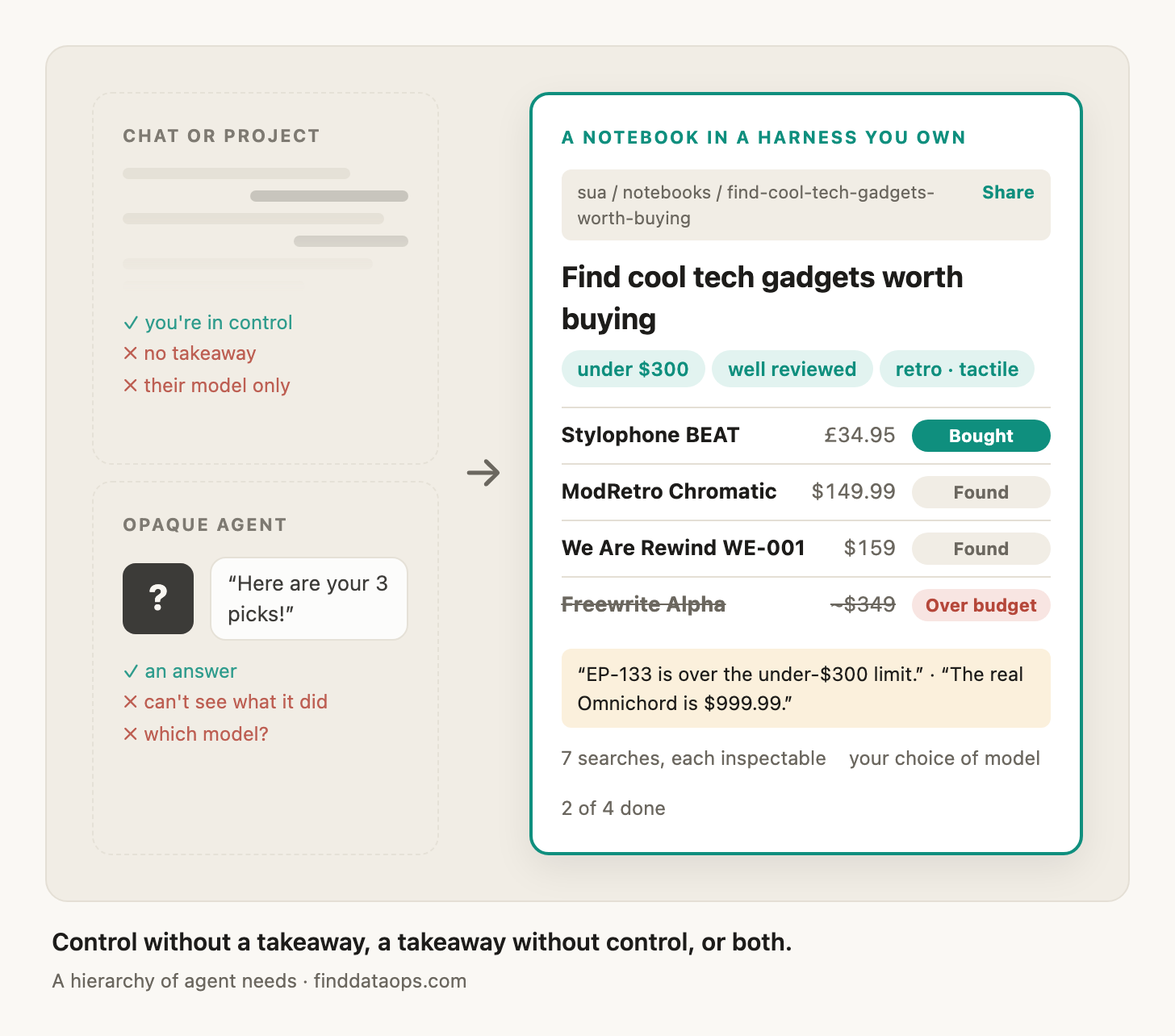
Here’s my concern over these new “personal” agents - you give up an undetermined amount of control to get an answer you should be able to get yourself, if you could only get better at piloting these tools.
When the “personal” agent gives you a result, you also don’t really know what it did. What did it search in relation to your goal? What did it discard? Which model did it ask to do the work? Mostly, you have no idea.
One option gives you control without a takeaway. The other gives you a takeaway without control.
I’ve been building a third option to do agentic work, mostly for funsies. It uses a locally run harness and the providers and tools I’ve made available to do work and report on what it finds.
Five days ago I typed one sentence into it: find cool tech gadgets worth buying.
It turned that into a goal (under $300, new, well reviewed, available now), four “done when” criteria, and four checks every pick had to pass.
The model also asked me what sort of style I wanted, so I wrote “retro, tactile, music-making, cassette players, something to write on.”
Seven searches later there’s a page with a dozen candidates: a Teenage Engineering EP-133 sampler, a Stylophone BEAT, two modern cassette players, a Playdate, an Analogue Pocket, a clear-shelled ModRetro Game Boy clone, and an Instax camera.
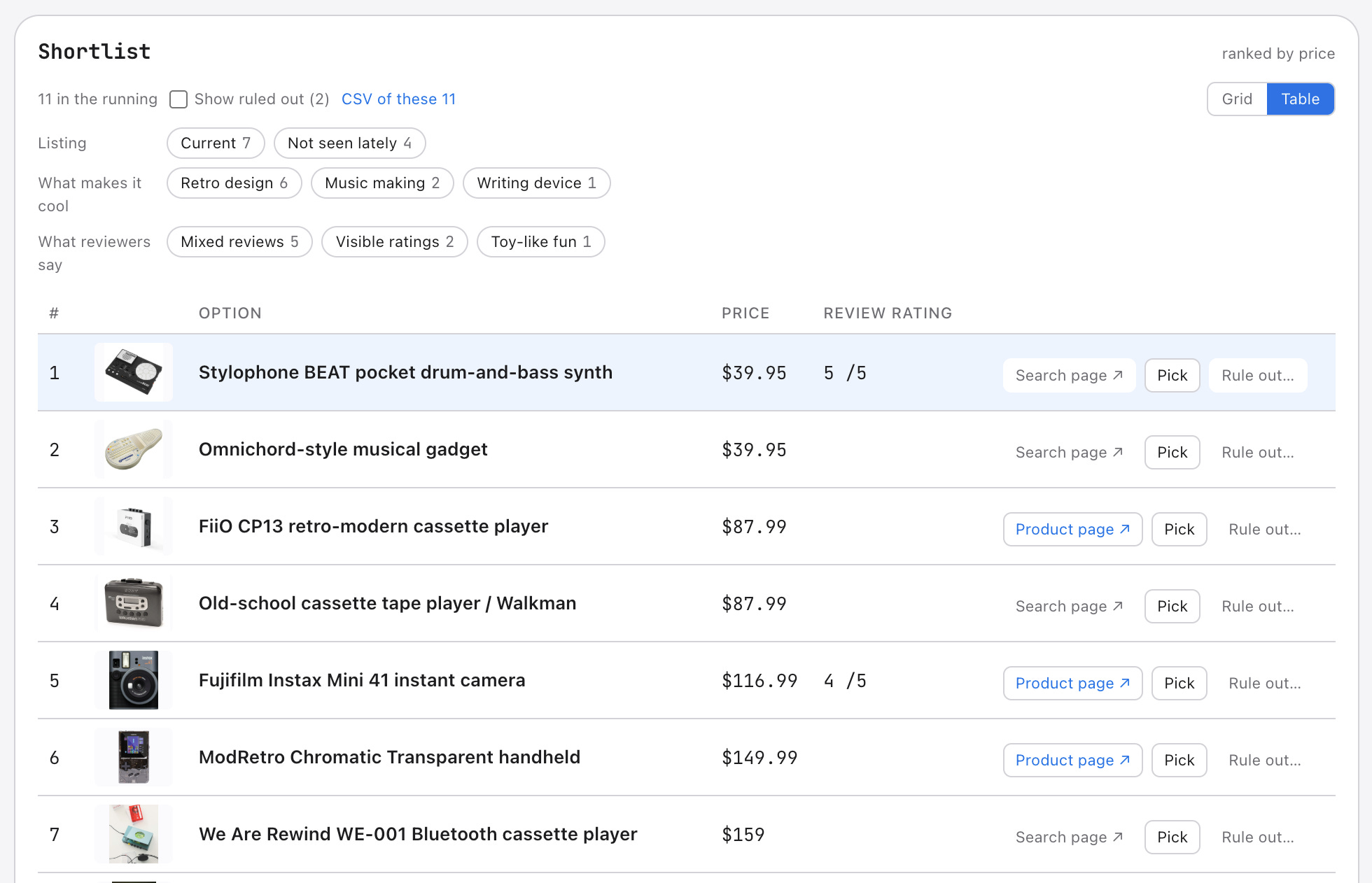
I decided to buy a Stylophone, mostly on the strength of their silly demo.
I call the page a notebook. It lives in some-useful-agents (SUA), the local agent harness I wrote about in Your chat should actually get work done.
The interesting part is that I couldn’t have built this output without following a process of building from the ground up.
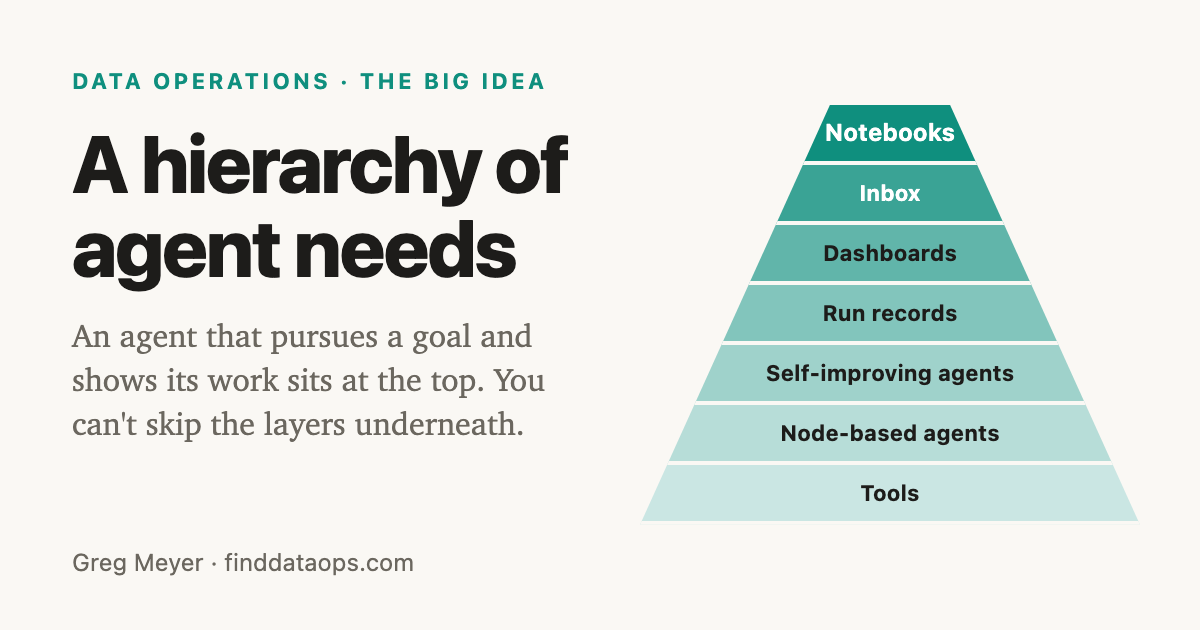
An agent that pursues a goal and shows its work sits at the top of a hierarchy of needs, and you can’t skip the layers underneath.
You can’t skip to the top
Abraham Maslow’s idea of the Hierarchy of Needs was that you don’t worry about belonging while you’re hungry — you need safety and security to think about higher level problems.
Agent systems are built on a similar pyramid of capabilities.
Nobody trusts a research assistant whose runs they can’t inspect
Nobody can inspect runs from agents that are one long prompt
And an agent can’t do much of anything without tools
I’ve been building each piece of the stack in my Some Useful Agents exploration, and notebooks (goal-based outcomes with persistence) are a logical next outcome. But they couldn’t have happened without the layers beneath them becoming routine.
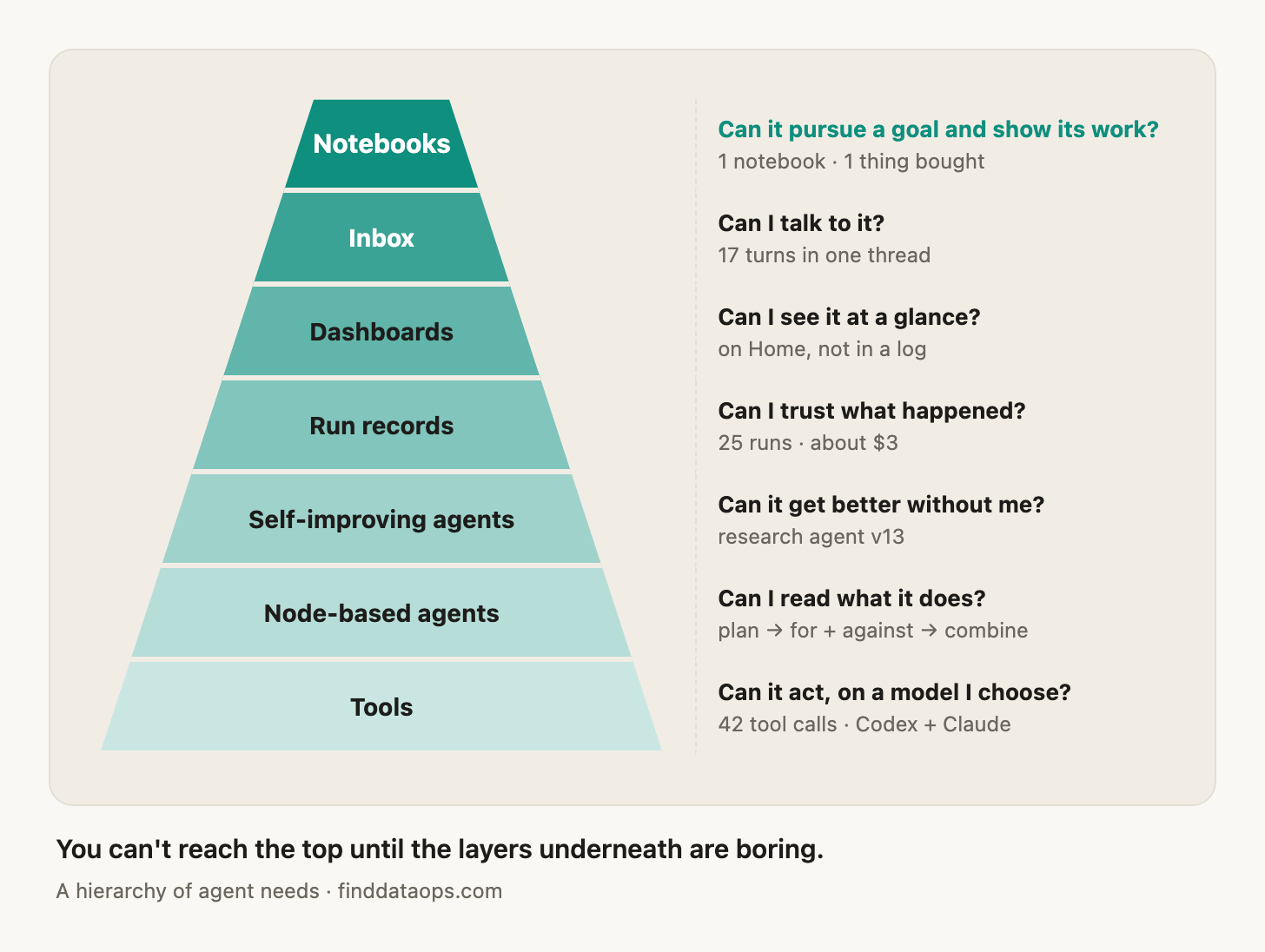
Here’s a summary of what I’ve built so far.
Foundation: can it act, and can I read what it does?
Tools. The first need is the ability to do things: search, fetch a page, write a file, run on a schedule. SUA has fifteen tools, and each one has limits on what it can touch. An agent that can fetch anything from anywhere isn’t a foundation, it’s a liability.
The model is a tool too, and that’s the part the chat platforms don’t give you. SUA is a harness, not a model. It runs Claude, Codex, a local Qwen model on my laptop, or Apple’s on-device model, and I choose which one each step uses. When one fails, the run falls through to the next one. My research isn’t stuck inside whichever platform I started it in.
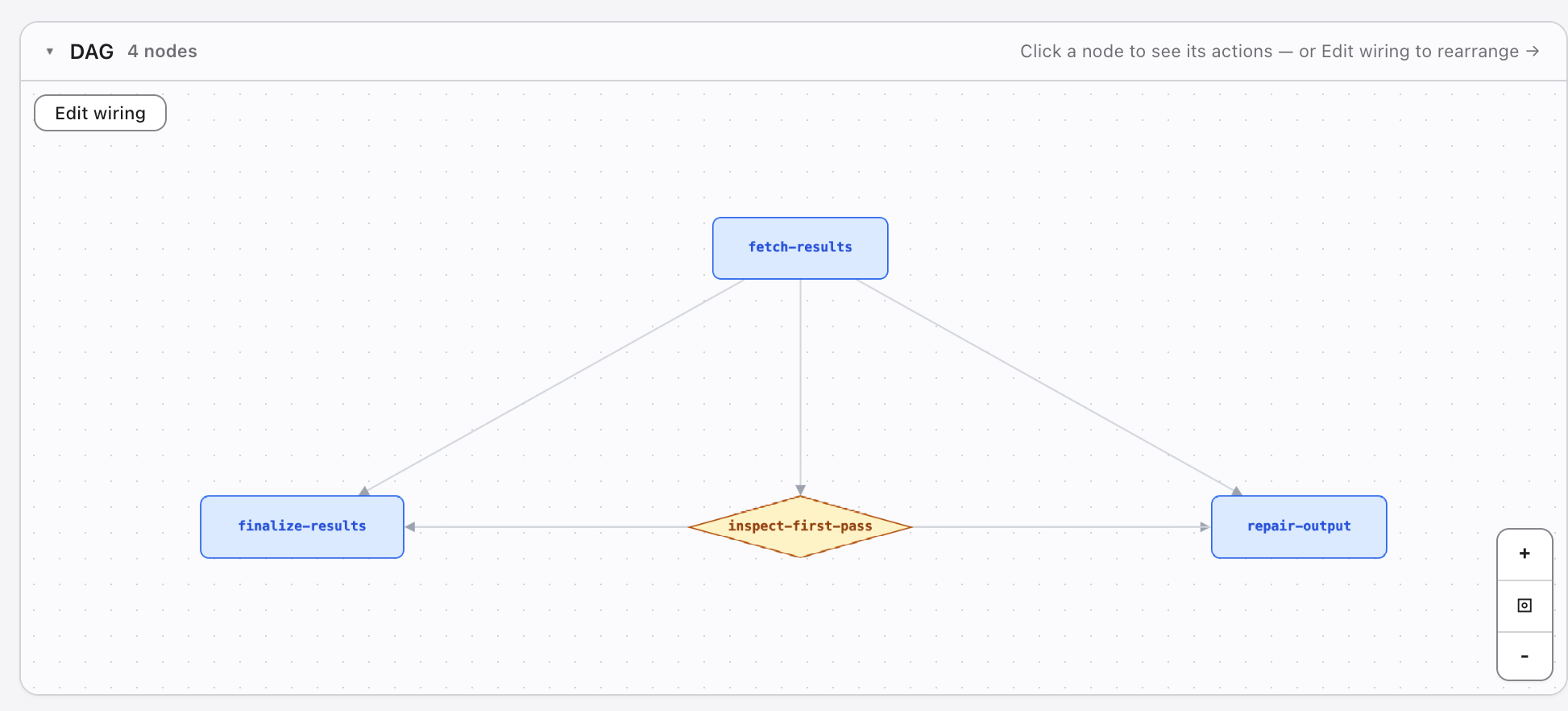
Node-based agents. The second need is legibility. An agent written as one long prompt is a black box. An agent built from nodes, where each node does one thing with one tool, is a pipeline you can read. Every SUA agent is a small diagram rather than a paragraph of instructions you have to trust.
Trust: can it get better, and can I see what happened?
Agents that improve agents. Once agents are pipelines, other agents can edit them. You describe a goal and the agent-builder designs the pipeline. “Suggest improvements” runs the agent-analyzer, which reviews an agent, checks its own fixes against the schema, and repairs them when they’re wrong. It’s recursive, and it only works because the pipeline underneath is deterministic.
A record of everything. Improvement needs evidence. Every run, node execution, and tool call is logged with inputs, outputs, and allowed actions. If you can’t see what happened, you can’t improve it, and you shouldn’t trust it. You also need to be thoughtful about what you log so that you don’t log unintended items.
Contact: can I see it, and can I talk to it?
Dashboards. Scheduled agents produce results while you’re doing something else. A dashboard turns those results into tiles you can read at a glance instead of logs you have to parse. This is the first layer where the system faces a person instead of a developer.
An inbox. Last time I argued that an inbox thread is a work request with a status, not a transcript. You ask, the system works out which agent should do the job, and the thread stays open until there’s a result. This is where it stopped feeling like operating software and started feeling like delegating.
However, a thread still isn’t an outcome.
The top: can it pursue a goal and show its work?
That’s the need the notebook meets, and building it was mostly wiring together some of the pieces I already had in the system.
When you create a goal, a find agent searches. A picture agent finds a photo for every option. A keeper agent files results onto the page and checks every number against what the search actually said.
A notebook page holds the goal and its limits. It lists the candidates, each with a picture, a source, and a reason it’s there. It also is able to establish a series of steps that need answering before the next search runs.
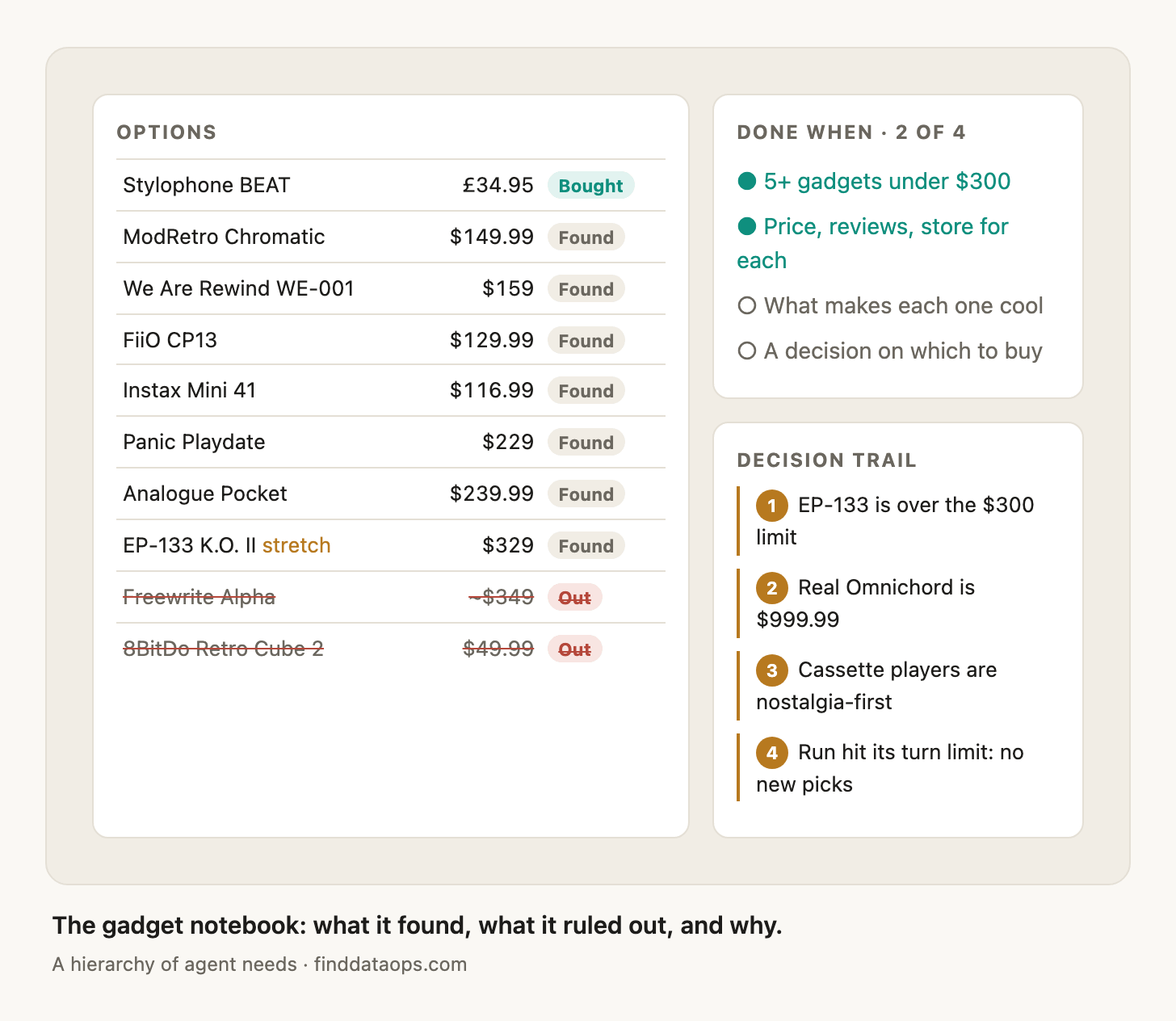
The decision trail is the part that makes it more than a list, because it records corrections as well as results. Here’s what the gadget notebook wrote down along the way:
“EP-133 is over the under-$300 limit.” The official price turned out to be $329, so it stayed as a stretch pick, not a match.
“The real Omnichord (Suzuki OM-108) is $999.99, about 3x the $300 cap.” My “Omnichord-style gadget” idea needed a cheaper alternative.
“Caution: modern cassette players are nostalgia-first purchases.” Of the two it found, the WE-001 was the safer buy.
“This run’s main research hit its turn limit: no new rated picks.” A run admitting it came back thin instead of padding the list.
None of that survives in a chat. You can talk to the question in a chat thread, but then it’s one of a million chat threads you have hanging out somewhere.
That’s why the artifact is the logical outcome of the hierarchy rather than a feature I happened to build.
The report is the memory. The model doesn’t need to remember your preferences if the page does. It’s the distillation of your inputs, the model’s outputs, and the current state of your search.
You might have noticed that this is non-deterministic. Yep, that’s because the inputs and outputs are moving. Think of a notebook as a placeholder where you can reorient yourself (and the models) to what you were thinking at the time, and also get a quick reorientation to where things have moved now.
The need above the top
Maslow put self-actualization at the top and stopped. I don’t think this pyramid is finished.
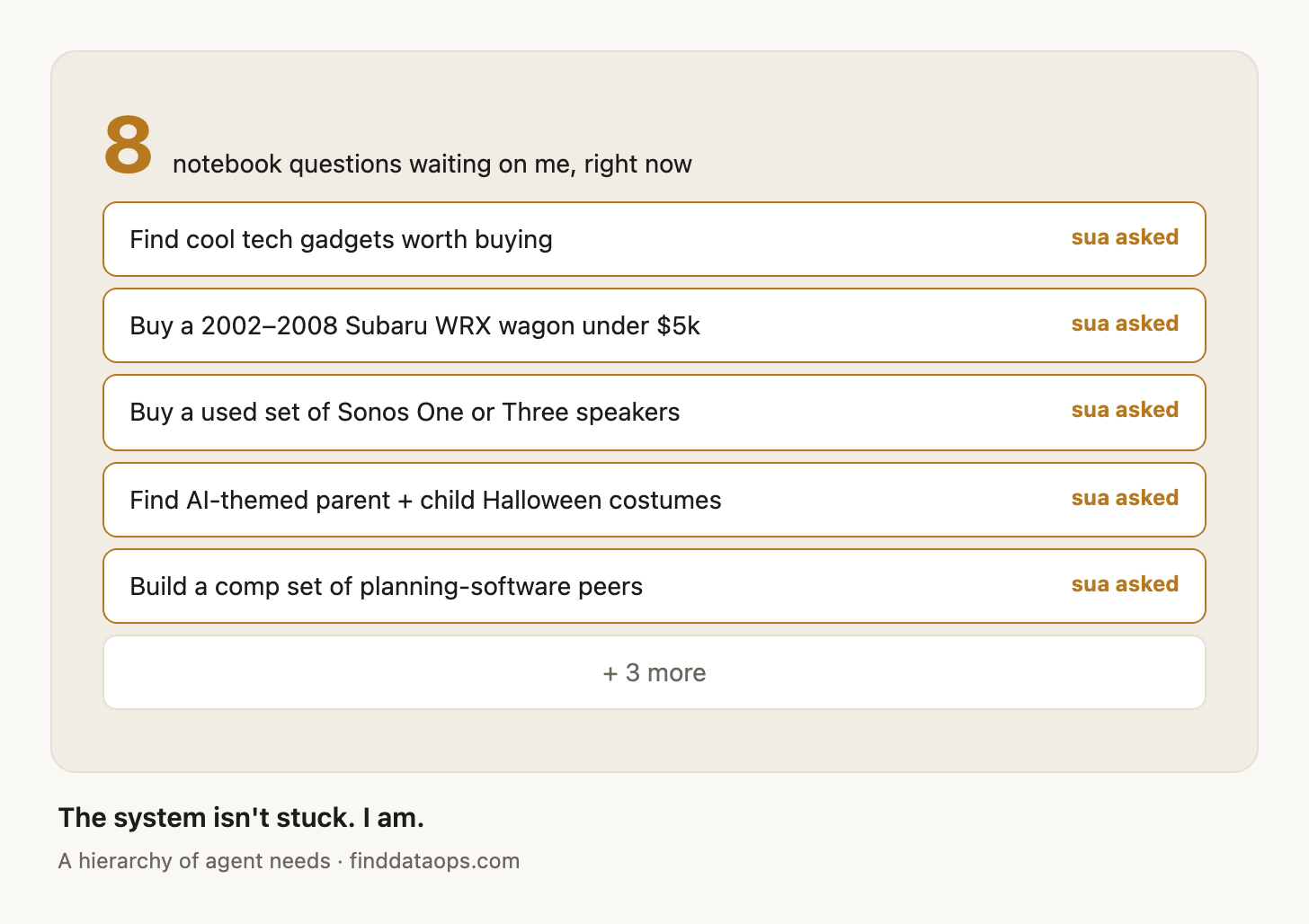
On my home screen right now, the “Needs you” section has eight notebook questions waiting on me. The system isn’t stuck. I am. Once the work keeps running, my attention becomes the bottleneck. A real assistant would know which of those eight matter this week and which can wait.
What’s the takeaway? As we start using AI tools for long-running questions and research, we need better first-class objects for thinking about those conversations, holding context, and sharing with other people. This notebook experiment with the some-useful-agents repo is my ongoing side quest to create an agent hierarchy.
Links for Reading and Sharing
These are links that caught my 👀
1/ “Shop” without shopping - I’m a fan of this art project that simulates what it feels like to spend lots of money shopping … without actually facilitating e-commerce. It feels like the real thing.
2/ Give Agents Tools To Point - This is a fun library that lets Agents create overlays on the screen - I’m excited to try it out. Hopefully creating boxes and arrows in an obviously goofy style will make it easier for folks to see them during instructional content.
3/ Have some bread - Friday was world bread day, and these examples are making me hungry.
What to do next
Hit reply if you’ve got links to share, data stories, or want to say hello.